As Amazon Associates, we earn from qualifying purchases. This means we may receive a small commission at no extra cost to you if you click through and make a purchase.
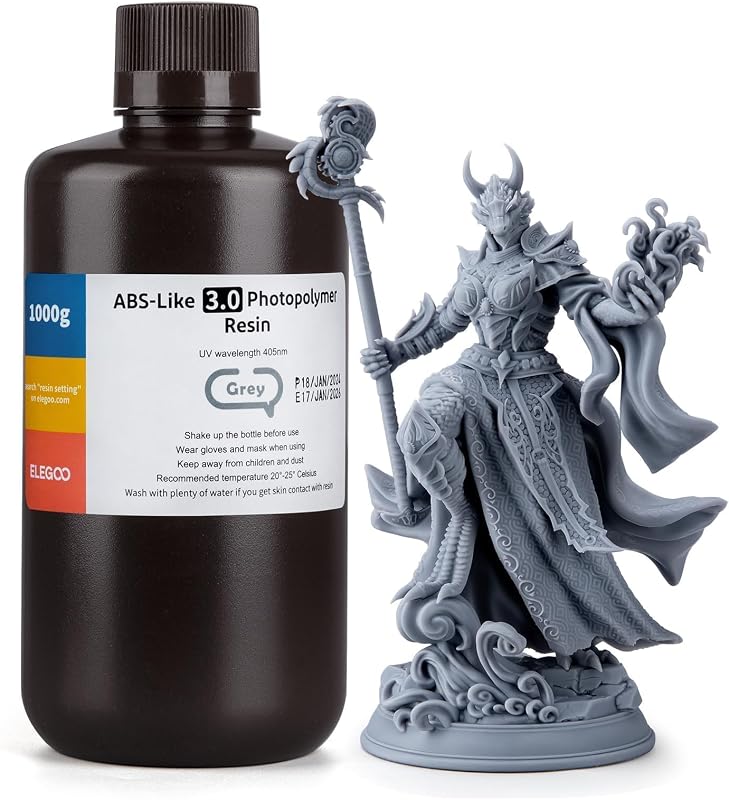
Engineers and prototyping technicians regularly encounter frustration when standard photopolymer resins shatter under minor mechanical impacts or crack during assembly. If your workflow involves functional enclosures, snap fits, or structural jigs, standard hobby resins simply lack the durability needed for mechanical validation. The ELEGOO ABS-Like 3.0 photopolymer formulation was developed directly to tackle this challenge, delivering enhanced impact tolerance and structural toughness to desktop light-curing systems. Designed for 405nm LCD and DLP printers, it gives product developers an accessible way to produce resilient components without upgrading to costly industrial platforms.
In this elegoo abs-like resin review, we examine the mechanical integrity, flow behavior, and dimensional stability of this third-generation formula. Our short verdict is that this material provides an exceptional balance of crack resistance, rapid fluid reflow, and dependable dimensional precision for engineering tasks. If you are assessing whether to adopt elegoo abs like for functional prototypes, this resin delivers the resilience needed to drill, fasten, and assemble working prototypes with confidence.
01 Quick Verdict
ELEGOO ABS-Like 3.0 is a highly practical, tough photopolymer that addresses the brittleness of standard resins while significantly improving cycle fluidity. It gives engineers and designers a reliable path to functional prototyping without the print failures often caused by thick, high-viscosity engineering fluids.
- High impact resistance allows post-print drilling and machining without brittle cracking.
- Formulated with 25 to 47 percent lower viscosity than earlier versions for faster layer recoating.
- Excellent chemical stability resists phase separation and eliminates the need for constant stirring.
- Broad 405nm UV compatibility functions smoothly across diverse LCD and DLP platforms.
02 ELEGOO ABS-Like 3.0 Features Explained
01 Impact Resistance and Mechanical Durability
Standard light-curing photopolymers often suffer from high brittleness, causing printed objects to shatter upon impact or fracture when subjected to torsional stress. The elegoo abs-like resin toughness is achieved through an engineered polymer structure designed to absorb energy and resist deformation under mechanical loads. According to the manufacturer data, components printed with this material can withstand post-processing operations like drilling holes and survive accidental drops, retaining their physical form without cracking or splitting.
This durability is especially valuable for mechanical assemblies, snap-fit clips, and working housings that encounter repeated handling during testing phases. While standard resins might snap when a screw is torqued into a pilot hole, this ABS-like formulation maintains its structural integrity. For engineering teams producing functional prototypes that must undergo handling, physical fitting, and functional testing, this resistance to shock dramatically lowers iteration scrap rates.
02 Dimensional Precision and Low Shrinkage
Part accuracy and assembly fitment depend heavily on how a photopolymer behaves during the cross-linking phase. A critical consideration in the elegoo abs-like vs standard resin comparison is volumetric contraction. The elegoo abs-like shrinkage profile is engineered to remain exceptionally low during UV exposure, preventing the warping, edge curling, and geometric bowing that ruin tight-tolerance components. This low shrinkage ensures that flat surfaces remain flat and concentric bores retain their roundness.
With minimal distortion, fine mechanical features such as interlocking tabs, shallow relief lettering, and precise alignment pins resolve cleanly. Designers do not need to apply aggressive dimensional scaling factors in slicer software just to get interlocking components to mate properly. For multi-part assemblies where several resin components must integrate with metal hardware, bearings, or off-the-shelf fasteners, this dimensional consistency provides dependable fitment right off the build plate.
03 High Fluidity for Rapid Layer Cycles
One common drawback of tough engineering photopolymers is sluggish viscosity, which impedes resin movement and increases release forces. ELEGOO ABS-Like 3.0 overcomes this hurdle with a low-viscosity chemistry that is 25 to 47 percent thinner than ABS-like 1.0 and ABS-like 2.0. This thin fluid flows back across the vat floor swiftly after every lift move, ensuring complete coverage over the optical exposure zone before the plate lowers again.
This enhanced fluidity facilitates cleaner release from release films and lowers the hydraulic peel forces exerted on fragile model supports. Machines featuring high-speed release mechanisms, such as the mars 4 ultra, can run shorter rest times without causing delamination or suction-induced tears. As a result, prototyping workshops can trim cumulative cycle times while maintaining high print success rates across complex, dense model layouts.
04 Chemical Suspension and Color Consistency
Resin formulations often suffer from phase separation, where heavy pigments settle to the bottom of the vat during extended pauses between prints. ELEGOO ABS-Like 3.0 is chemically engineered for strong suspension stability, preventing pigment stratification and component separation over prolonged periods. You do not need to constantly drain the vat or agitate the liquid with a plastic spatula before starting a print run after the machine has sat idle overnight.
This stability guarantees that pigment particles stay evenly distributed throughout the bottle and vat, producing a completely uniform grey finish across the entire surface of your prints. Without color streaks, mottled patches, or uneven curing caused by pigment pooling, parts come off the printer looking clean and professional. For design reviews and client presentations, this consistent visual quality presents functional concepts clearly without requiring post-print painting.
05 Universal 405nm Hardware Compatibility
A major operational advantage for busy workshops is material compatibility across diverse 3D printer hardware. ELEGOO ABS-Like 3.0 is optimized for the standard 405nm ultraviolet wavelength utilized by the vast majority of LCD and DLP resin 3D printers. Although the manufacturer notes that it works best with ELEGOO light-curing printers, the universal photoinitiator package allows it to polymerize reliably across various open-material desktop printers.
Whether you are operating an entry-level platform such as the elegoo mars 5 or a large-format commercial vat machine, the resin cures predictably across monochrome optical engines. This broad compatibility enables laboratories and makerspaces to standardize their resin stock on one reliable material. Instead of stocking specialized resins for every printer brand, technicians can use this single material across all 405nm LCD setups.
03 Specs
Reviewing the elegoo abs-like 3.0 specs reveals key physical and packaging parameters provided by the manufacturer:
| Attribute | Detail |
|---|---|
| Brand | ELEGOO |
| Product Name | ELEGOO ABS-Like 3.0 3D Printer Resin Grey 1000g |
| Item Model Number | Cinza3.0 1KG |
| Net Material Quantity | 1000g (1 kg) |
| Package Weight | 2.64 pounds |
| Package Dimensions | 9.37 x 3.86 x 3.86 inches |
| Curing Wavelength | 405nm UV light-curing technology |
| Viscosity Metric | 25% to 47% lower viscosity than ABS-like 1.0 and 2.0 |
| Color Finish | Grey |
| Intended Systems | LCD and DLP 3D printers |
04 ELEGOO ABS-Like 3.0 Pros and Cons
Pros
- Withstands mechanical drilling and moderate impacts
- Significantly reduced viscosity for rapid recoating
- Lower volumetric shrinkage maintains dimensional precision
- Stable chemical formulation resists pigment separation
- Universal 405nm compatibility across LCD and DLP printers
Cons
- Listing does not specify exact per-machine exposure settings
- Does not include cleaning accessories or curing equipment
- Single 1000g grey bottle option in listing
05 Best Use Cases
Thanks to its impact-resistant polymer backbone and fluid characteristics, this material fits several specific engineering and modeling workflows:
- Functional prototyping of electronic housings, enclosures, and brackets that require post-print drilling or self-tapping screw insertion.
- Mechanical assemblies featuring snap-fit latches, friction hinges, or interlocking gears that must resist fracturing under physical tension.
- Rapid turnaround prototyping runs where low resin viscosity allows shortened wait times and faster lift speeds on high-output LCD printers.
- Dimensional verification models where low volumetric shrinkage is necessary to validate clearances before starting expensive injection tooling.
- Aesthetic presentation components that benefit from a uniform grey surface finish without visible pigment stratification or color banding.
06 Before You Buy
Before purchasing ELEGOO ABS-Like 3.0, consider your complete workshop setup and post-processing equipment. While this material cures under standard 405nm UV light found across most desktop LCD and DLP printers, photopolymer printing involves distinct chemical safety requirements. If you are transitioning from filament extrusion printers like the neptune 3d printer, remember that resin prints require thorough washing in isopropyl alcohol, support removal, and secondary ultraviolet post-curing. The listing does not specify included cleaning accessories, wash containers, or protective gear, so make sure your workstation is equipped with appropriate safety supplies and washing stations before opening the bottle.
It is also essential to evaluate the specific product documentation and available metrics. The listing details a single 1000g bottle under model number Cinza3.0 1KG in grey, but does not specify multi-pack options or additional color variations in this specific entry. Furthermore, while the manufacturer highlights impact resistance, reduced shrinkage, and lower viscosity, the listing does not specify explicit numeric values for tensile strength, elongation at break, or exact per-layer elegoo abs-like print settings. Because optimal elegoo abs-like curing time depends on light intensity, screen transmission, and layer thickness, you will need to perform a baseline exposure test to calibrate settings for your printer.
07 How It Compares With Similar Picks
| Product | Best For | Key Difference |
|---|---|---|
| ELEGOO ABS-Like 3.0 | Functional prototypes and mechanical assemblies | Engineered for impact resistance, drilling capability, and 25-47% lower viscosity than earlier versions. |
| SUNLU Standard 3D Printer Resin | Budget-conscious decorative and general display prints | Standard photopolymer resin supporting 395-405nm UV light, offering high precision but without ABS-like impact durability. |
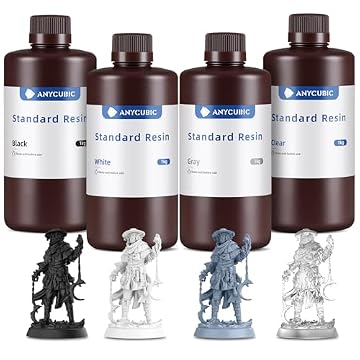
| ANYCUBIC 3D Printer Resin Bundle | High-volume multi-color printing across large batches | Four-bottle multi-color assortment (4kg total) geared toward basic fast curing rather than enhanced toughness. |
Selecting between these options comes down to your project requirements for mechanical durability versus raw material volume or color selection. The SUNLU Standard 3D Printer Resin provides an effective, general-purpose photopolymer for display figures and basic visual models, supporting a slightly wider 395-405nm curing band, but it remains brittle under shear loads or drilling. On the other hand, the ANYCUBIC 3D Printer Resin Bundle provides four distinct colors across four individual 1kg bottles, making it an attractive multi-pack for makers seeking high volume for aesthetic prints. However, for functional engineering assemblies that demand genuine crack resistance, screw fastening, and low shrinkage, ELEGOO ABS-Like 3.0 is the dedicated choice.

08 Bottom Line
For prototyping engineers and workshop technicians, ELEGOO ABS-Like 3.0 solves the longstanding dilemma of photopolymer brittleness without introducing the workflow bottlenecks of sluggish, viscous specialty resins. Its reduced viscosity accelerates resin replenishment across the release film, facilitating faster peel cycles and minimizing print failures. At the same time, the enhanced polymer toughness allows parts to survive direct drops, mechanical drilling, and snap-fit assemblies that would destroy standard photopolymer models.
While heavy-duty production applications exposed to extreme industrial chemicals or elevated temperatures still demand high-end commercial resins, this formulation is an outstanding material for everyday functional verification. So, is elegoo abs-like worth it for your workshop? If your projects require dependable dimensional stability, smooth surface definition, and genuine mechanical resilience on a 405nm desktop printer, this resin delivers a decisive, high-value solution for your prototyping workflow.
09 FAQ
Can you drill and tap holes into ELEGOO ABS-Like 3.0 models?
Yes, the resin is formulated specifically with high impact resistance and toughness to tolerate mechanical drilling and thread tapping without cracking or splintering like standard photopolymers.
What UV light wavelength is required for this resin?
ELEGOO ABS-Like 3.0 uses 405nm UV light-curing technology, making it compatible with the vast majority of LCD and DLP 3D printers on the market.
Does this resin separate or settle during idle periods?
The formula is engineered with strong chemical stability that prevents delamination and pigment sedimentation, eliminating the need for frequent manual stirring between jobs.
How does the viscosity of version 3.0 compare to previous versions?
Version 3.0 features a viscosity that is 25 to 47 percent lower than ABS-like 1.0 and ABS-like 2.0, allowing faster resin flow and easier release from the film.
Does the product package include specific print settings for third-party printers?
The listing does not specify exact per-layer exposure settings for individual third-party machines, so running an exposure test calibration matrix on your specific hardware is recommended.
What is the bottle size and package weight of this product?
The product comes as a 1000g (1 kilogram) bottle of grey resin, with a total package shipping weight of 2.64 pounds according to the listing data.