As Amazon Associates, we earn from qualifying purchases. This means we may receive a small commission at no extra cost to you if you click through and make a purchase.

For engineering teams, prototyping labs, and high-throughput print farms, material management often introduces subtle friction that degrades daily productivity. Slicing misconfigurations, spool feeding errors, and filament runout checks consume valuable operator hours. High-volume 3D printing requires predictable feed rates, exact thermal behavior, and minimal manual intervention. The Bambu Lab PLA Basic addresses this operational bottleneck by pairing standard polylactic acid with native hardware integration, specifically targeting professionals who rely on automated workflows to maintain production deadlines. Choosing the right bambu labs pla basic filament setup allows operations to move away from constant parameter tweaking and toward uninterrupted output.
Our verdict is unequivocal: Bambu Lab PLA Basic is an outstanding production-grade filament for teams using compatible ecosystems, where its automated recognition system virtually eliminates setup overhead. While generic PLA rolls may look identical on paper, the zero-calibration convenience and mechanical spool design provide measurable efficiency gains that justify its role in professional workspaces.
01 Quick Verdict
Bambu Lab PLA Basic delivers seamless automated feeding, high dimensional consistency, and reliable extrusion across rapid prototyping cycles, making it the premier choice for production facilities seeking hands-off operation.
- Integrated RFID chip triggers automated material identification and instant profile loading in slicing software.
- Tight dimensional tolerance of 1.75mm with +/- 0.03mm variance ensures stable flow rates during accelerated deposition.
- Full mechanical compatibility with the automated multi-material system eliminates feeding jams and rewind stalls.
- Supplied on an eco-conscious reusable spool assembly designed to minimize plastic waste across repeated production runs.
02 Bambu Lab PLA Basic Features Explained
01 RFID Automation and Ecosystem Integration
The defining capability of this bambu lab rfid filament is its built-in near-field identification tag embedded directly inside the spool hub. When dropped into an AMS unit, the system scans the tag to read the exact material type, color code, and production profile instantly. This hands-off handshake synchronizes with the slicer software without requiring manual operator input. For facilities running multi-machine operations such as the bambu labs x1 series, eliminating manual preset selection significantly reduces human error, preventing costly print failures caused by incorrect nozzle temperatures or cooling curves.
Beyond initial setup, the RFID tracking communicates real-time spool consumption back to the management interface. Operators can monitor remaining filament volume visually and configure automated runout handling across multi-bay configurations. When paired with a dedicated bambu lab ams array, the machine automatically swaps to an adjacent spool of matching filament once the primary roll depletes, enabling continuous overnight production runs without workflow interruption.
02 High-Speed Dimensional Accuracy and Consistency
Operating at elevated deposition speeds demands exceptional physical tolerance along the entire length of the strand. Bambu Lab PLA Basic is manufactured to maintain a strict diameter specification of 1.75mm within a +/- 0.03mm tolerance. In fast-motion toolheads, subtle diameter fluctuations lead to backpressure variance inside the melt zone, manifesting as under-extrusion gaps or unsightly surface banding. The precise diameter control ensures that volumetric extrusion calculations remain consistent from the first layer to the final top surface.
This physical consistency allows the filament to handle rapid acceleration without buckling or binding inside the extruder gears. Utilizing bambu lab pla basic for fast printing ensures that high volumetric flow rates do not compromise layer bonding or geometric fidelity. The melt characteristics liquefy rapidly under high thermal transfer while cooling swiftly upon deposition, preserving crisp bridges, sharp overhangs, and clean corners under aggressive travel speeds.
03 AMS Mechanical Reliability and Spool Architecture
Filament transport issues represent one of the most common points of failure in multi-material systems. Bambu lab pla ams compatibility is engineered into both the polymer formulation and the spool housing. Generic spools, particularly cardboard variants, often shed fibrous debris inside the drive rollers or feature uneven rims that slip during high-torque rewind sequences. The rigid plastic construction of this spool ensures consistent traction against motorized rollers during continuous feeding, retracting, and swapping routines.
The winding process is tightly managed to prevent cross-under snarls, overlapping loops, or tension spikes that could stall the drive motors. Because the automated material system relies on precise tension feedback to detect runout and retraction limits, the uniform spool winding ensures steady resistance throughout the entire 1kg capacity. This mechanical stability translates directly into higher print success rates during intricate multi-stage projects.
04 Material Toughness and Surface Quality
While standard polylactic acid is often considered brittle, this formulation features enhanced toughness and structural impact resistance. It resists snap failures inside the PTFE guide tubes, even when routed through tight bends across multi-unit printing setups. The resulting bambu lab filament print quality is evident in clean surface finishes, uniform sheen, and crisp vertical wall definitions that minimize the need for post-processing or cosmetic finishing.
In the specific Bambu Lab Jade White PLA variant, the pigmentation provides clean opacity that hides internal infill patterns without requiring excessive wall perimeters. The high-opacity formulation yields clean visual models, architectural maquettes, and functional enclosure prototypes. It bonds securely to standard build surfaces, such as a textured or smooth bambu lab p1s plate, releasing cleanly once the surface cools to room temperature.
05 Reusable Spool System and Environmental Efficiency
Production printing generates significant plastic waste through discarded single-use spools. This product comes equipped with a Bambu Lab filament reusable spool assembly, allowing operators to transition to refill packs once the initial material is consumed. The two-piece spool unlatches with a simple twist-and-pull motion, letting technicians install core-only refills quickly while retaining the structural outer flanges and RFID-ready hub.
This reusable design reduces plastic consumption per kilogram of printed material and optimizes storage density within busy workshops. The spool body incorporates visual capacity gauges molded into the clear flanges, giving shop managers an instant physical estimate of remaining material alongside the digital slicer readouts. It represents an efficient, low-waste approach that aligns with lean manufacturing principles.
03 Specs
Reviewing the bambu lab pla basic specs confirms its tight physical tolerances, production-grade material properties, and automated integration standards.
| Specification Attribute | Technical Detail |
|---|---|
| Material Formulation | Polylactic Acid (PLA) |
| Nominal Diameter | 1.75 mm |
| Diameter Tolerance | +/- 0.03 mm |
| Spool Net Weight | 1 kg (2.2 lbs) |
| Color Pigmentation | Jade White |
| Spool Type | Two-piece reusable plastic assembly |
| Tracking Technology | Integrated RFID tag for automatic print settings |
| System Integration | AMS compatible, MakerWorld model library ready |
| Manufacturer Part Number | A00-W1-1.75-1000-spl |
| Manufacturer | BAMBULAB Shenzhen Tuozhu Technology Co., Ltd |
04 Bambu Lab PLA Basic Pros and Cons
Pros
- RFID auto-configuration saves setup time
- Tight +/- 0.03mm diameter consistency
- Seamless AMS multi-material reliability
- Reusable spool frame cuts plastic waste
- Tough formulation prevents feed tube snapping
Cons
- RFID recognition exclusive to Bambu ecosystem
- Listing includes no spare desiccant or vacuum bags
05 Best Use Cases
- Automated overnight prototyping where RFID detection and seamless spool runout management eliminate operator intervention.
- High-speed functional testing runs that leverage tight +/- 0.03mm diameter tolerances to prevent backpressure extrusion errors.
- Multi-material printing workflows requiring friction-free retraction and feeding cycles within an AMS hardware setup.
- Architectural models and concept presentation prints that require the opaque, clean surface finish of Jade White PLA.
- Production environments seeking lean material practices through the adoption of reusable spool infrastructure.
06 Before You Buy
Before integrating Bambu Lab PLA Basic into your facility, evaluate hardware compatibility and workflow goals. While the filament uses standard 1.75mm dimensions suitable for nearly any FDM 3D printer, the primary value propositions—such as RFID auto-detection and automated material switching—require a Bambu Lab ecosystem with an AMS or AMS-compatible unit. When loaded into third-party open-source printers or smaller desktop machines like the bambu labs a1 mini without an AMS, the filament behaves like standard high-grade PLA, requiring manual parameter entry for temperatures, retraction, and flow dynamics.
Additionally, take note of what the product package delivers. This listing includes a single 1kg spool of Jade White PLA pre-assembled on a reusable plastic spool with an RFID chip. The listing does not specify secondary accessories, such as spare desiccant packs, replacement vacuum bags, or secondary nozzles. Future refills can be purchased as spool-less bundles to reuse the supplied plastic frame, but initial setup requires storing the spool in an airtight enclosure to prevent ambient moisture absorption over extended production schedules.
07 How It Compares With Similar Picks
| Product | Best For | Key Difference |
|---|---|---|
| Bambu Lab PLA Basic | Automated rapid prototyping and AMS production runs | Full 1kg spool with RFID auto-detection and reusable spool frame |
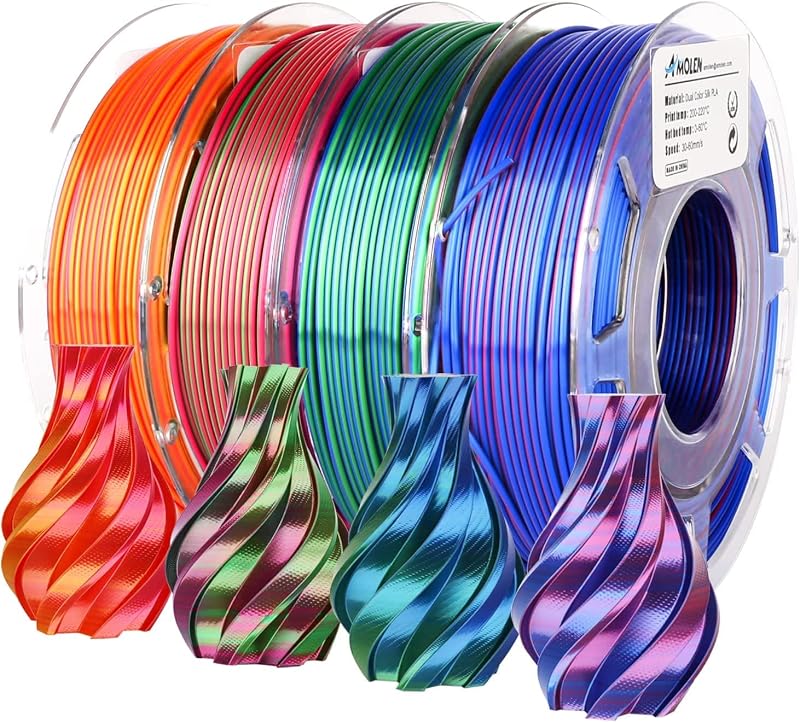
| AMOLEN Silk PLA 3D Printer | Decorative prints and multi-tone aesthetic projects | Four small 200g spools featuring shiny dual-color shift effects |
| Beginner Friendly Multicolor Bundle | Hobbyists exploring broad color palettes on a budget | Eight-roll bundle of 250g spools across eight distinct primary colors |
| 200g Spool Bundle 3D Printer | Specialty novelty parts requiring illumination or silk sheens | Eight 200g spools combining glow-in-the-dark PLA+ and tricolor silk |
Selecting between these alternatives depends entirely on whether your priority is manufacturing efficiency or visual experimentation. If your workflow demands standardized structural parts, high dimensional precision, and automated material configuration, Bambu Lab PLA Basic is the clear operational choice. Conversely, if your project calls for small-batch decorative models, rainbow effects, or vibrant multi-color samples without needing a full 1kg roll of a single hue, bundles like the AMOLEN Silk PLA 3D Printer, Beginner Friendly Multicolor Bundle, or 200g Spool Bundle 3D Printer offer greater visual variety in miniature quantities, albeit without automated RFID recognition or standardized production spooling.
08 Bottom Line
For operators evaluating whether is bambu lab pla basic worth it, the answer depends on how much you value unattended machine hours. By combining tight manufacturing tolerances of +/- 0.03mm with frictionless RFID automation, this filament eliminates the repetitive calibration steps that slow down professional prototyping. It operates reliably within automated feed systems, minimizing manual oversight and ensuring predictable, high-yield results across continuous fabrication cycles.
While general-purpose filaments may suffice for recreational prints, the operational gains offered by Bambu Lab PLA Basic make it an exceptional standard for busy professionals, engineering studios, and commercial print operations. If you utilize an AMS workflow and require consistent, high-speed part output without mechanical feeding headaches, standardizing on this filament is an efficient, high-value investment in shop productivity.
09 FAQ
Does the RFID chip work on non-Bambu 3D printers?
No, the integrated RFID chip communicates specifically with Bambu Lab AMS units and Bambu Studio software. Third-party 3D printers lack the proprietary near-field hardware and reader protocols required to scan the spool tag. On non-Bambu machines, this filament functions as standard 1.75mm PLA, requiring operators to manually configure nozzle temperatures, bed temperatures, and extrusion speeds.
Can the reusable spool be used with other filament brands?
The reusable spool is engineered to accommodate Bambu Lab refill packs, featuring alignment notches and locking tabs tailored to that standard. While some third-party filament refills with compatible core dimensions can technically fit, the listing does not specify universal compatibility with other manufacturer refills. For reliable feeding in AMS units, using matched refills is recommended.
What printing speeds can Bambu Lab PLA Basic handle?
Bambu Lab PLA Basic is optimized for high-speed printing environments, supporting fast linear travel and rapid volumetric extrusion rates without layer separation. While the listing highlights fast printing capabilities, exact speeds depend on nozzle diameter, hotend flow limits, and cooling fan performance. It maintains dimensional fidelity and thermal stability even under accelerated toolhead movement.
How does the +/- 0.03mm tolerance impact print quality?
A tolerance of +/- 0.03mm ensures uniform volumetric flow through the extruder, preventing sudden pressure spikes or drops inside the hotend. This consistency prevents common print flaws such as surface banding, pimples, stringing, and micro-voids, producing smooth layer transitions and dimensionally accurate functional prototypes.
Does Jade White PLA require special drying before printing?
Like all polylactic acid materials, Bambu Lab PLA Basic performs best when kept dry, as ambient moisture can cause steam expansion in the nozzle, resulting in stringing and surface roughness. The spool comes vacuum-sealed from the factory, but for long-term use in humid environments, storing it in an airtight dry box or desiccant-equipped AMS unit preserves optimal print quality.
What is the benefit of the MakerWorld model library integration?
The MakerWorld model library provides pre-configured slicing profiles and models that align directly with Bambu Lab materials and hardware presets. This allows users to download, slice, and print verified files with optimized print orientation, support settings, and temperature targets tailored directly to Bambu Lab PLA Basic.