As Amazon Associates, we earn from qualifying purchases. This means we may receive a small commission at no extra cost to you if you click through and make a purchase.
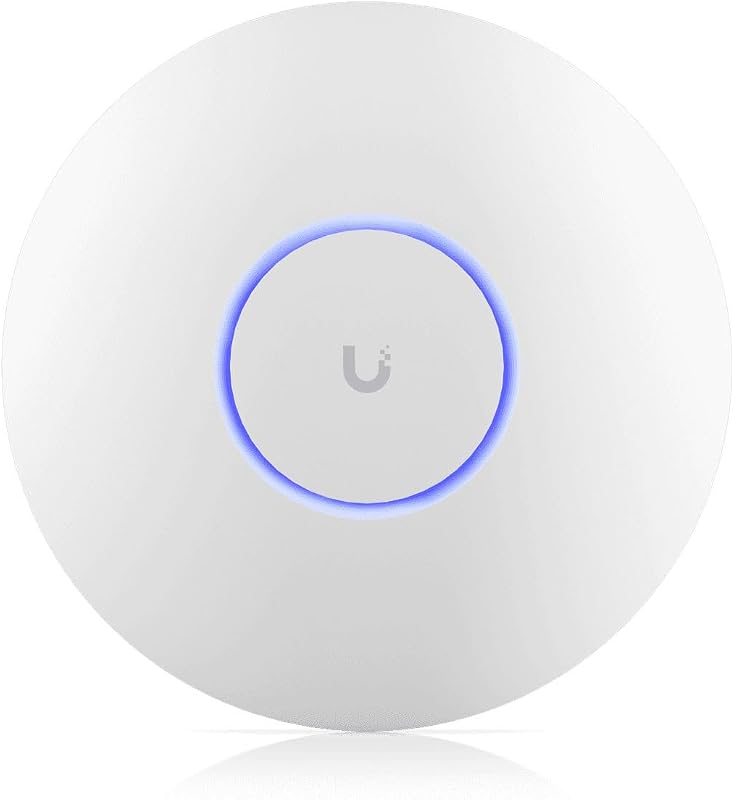
Modern office spaces and dense commercial facilities constantly battle RF saturation, channel collisions, and bandwidth bottlenecks caused by hundreds of active mobile devices. When high-bandwidth collaboration tools meet legacy wireless infrastructure, network latency spikes and productivity collapses. The Ubiquiti UniFi U7 Pro Max is engineered specifically to eliminate these bottlenecks by introducing unifi u7 pro max wifi 7 tri-band connectivity alongside high-density stream multiplexing. Built for enterprise environments where wireless congestion threatens daily operations, this ceiling-mounted unit provides administrators with the spectral headroom and multi-gigabit throughput required to support dozens of concurrent users without data degradation.
Our architectural assessment indicates that this access point establishes a new benchmark for high-throughput enterprise wireless deployments. By coupling a massive aggregate speed capacity of 8.60 Gbit/s with a dedicated radio for continuous spectral scanning, the hardware solves the twin problems of airtime exhaustion and sudden co-channel interference. If your infrastructure demands seamless multi-gigabit routing and extensive client density, integrating this access point alongside a central management gateway like the ubiquiti dream machine delivers enterprise-grade stability. It stands out as an uncompromising solution for IT directors who need future-proof wireless performance today.
01 Quick Verdict
The Ubiquiti UniFi U7 Pro Max is an enterprise-focused tri-band access point that excels in dense, high-interference environments by combining WiFi 7 capabilities with dedicated spectral monitoring. It delivers immense wireless throughput and advanced client handling, provided your switching backhaul can accommodate its 2.5G uplink and 25 W power consumption.
- 8 spatial streams paired with tri-band coverage across 2.4 GHz, 5 GHz, and 6 GHz frequencies.
- Dedicated spectral scanning engine for continuous real-time interference detection in complex RF environments.
- High-bandwidth 2.5 Gigabit Ethernet port designed to prevent uplink bottlenecks.
- Total aggregate wireless capacity reaching up to 8.60 Gbit/s across supported IEEE 802.11 standards.
02 Ubiquiti UniFi U7 Pro Max Features Explained
01 Tri-Band WiFi 7 and Spatial Stream Capacity
The core architectural advantage of the u7 pro max ubiquiti hardware lies in its tri-band implementation, which unlocks the pristine 6 GHz frequency alongside legacy 5 GHz and 2.4 GHz channels. Utilizing IEEE 802.11be standards, the ubiquiti u7 pro max 6 ghz operation provides wide, uncontested spectrum channels that avoid the radar interference and legacy overhead typical of older frequencies. With 8 spatial streams distributed across its radios, the access point concurrently processes massive data loads using Multi-User MIMO (MU-MIMO) technology. This distribution ensures that demanding clients receive dedicated stream capacity without starving background endpoints.
In addition to 802.11be, the device maintains full backward compatibility with IEEE 802.11a/b/g/n/ac/ax protocols, allowing mixed fleets of enterprise hardware to associate seamlessly. Advanced roaming protocols, including 802.11k, 802.11r, and 802.11v, facilitate rapid client handoffs across access points in large facilities, preventing dropped voice-over-IP sessions or disrupted video conferences. Reaching an aggregate throughput capacity of 8.60 Gbit/s, the radio subsystem effortlessly manages high-density meeting halls, modern open-plan offices, and auditoriums.
02 Dedicated Spectral Scanning Engine
In commercial wireless engineering, intermittent RF interference from rogue transmitters, adjacent corporate networks, or industrial equipment can ruin client performance. The u7 pro max spectral scanning engine resolves this challenge by utilizing an independent radio receiver dedicated entirely to RF environment analysis. Unlike standard access points that must briefly interrupt client traffic or rely on off-channel background slicing to survey radio bands, this unit conducts continuous, real-time RF audits without introducing latency or dropping client packets.
To access this real-time spectral analysis functionality, your controller environment must run UniFi Network version 8.2.93 or later. Once active within UniFi OS, administrators gain granular visibility into channel utilization, noise floors, and active interference sources across all three bands. This actionable telemetry enables automated or administrator-driven channel optimization, ensuring critical corporate SSIDs always broadcast on the cleanest possible frequencies.
03 Multi-Gigabit 2.5G Uplink Architecture
Delivering high aggregate wireless throughput is meaningless if the physical backhaul creates a bottleneck. The ubiquiti u7 pro max 2.5g uplink addresses this constraint by incorporating a 2.5 Gigabit Ethernet RJ-45 interface, doubling the data pipeline capacity compared to traditional single-gigabit uplinks. This multi-gigabit pipe allows the unit to channel multi-stream WiFi 7 traffic into the core switching layer without saturating the physical wire.
The single RJ-45 network connection also supplies power to the unit, operating at a maximum consumption rating of 25 W. Network engineers deploying this unit must ensure their switching infrastructure provides adequate Power over Ethernet budgets to support this power profile under full client load. For organizations modernizing their routing infrastructure with an enterprise console like the udm pro max, this 2.5G uplink creates a balanced, non-blocking pipeline from edge client to gateway.
04 Enterprise UniFi OS Ecosystem Integration
Deploying the ubiquiti u7 pro max for business environments integrates directly with UniFi OS, providing a unified pane of glass for device adoption, configuration, and long-term maintenance. Through the centralized management console, network administrators can rapidly provision complex Virtual LANs, isolate guest networks, set up multi-SSID profiles, and apply enterprise security standards without complex command-line scripting.
The interface simplifies radio resource management by translating complex RF telemetry into clear visualizations. Network teams can monitor per-client metrics, track spatial stream utilization, and review historical performance data to preemptively address capacity issues before end users report degraded connectivity. This level of granular visibility makes large multi-AP deployments predictable and straightforward to maintain.
03 Specs
| Specification | Detail |
|---|---|
| Model Number | U7-PRO-MAX-US |
| Wireless Standard | WiFi 7 (IEEE 802.11a/b/g/n/ac/ax/be/k/r/v) |
| Frequency Bands | Tri-Band: 2.4 GHz, 5 GHz, 6 GHz |
| Spatial Streams | 8 Spatial Streams |
| Maximum Throughput | 8.60 Gbit/s Aggregate |
| Uplink Interface | 1 x 2.5 Gigabit Ethernet (RJ-45) |
| Operating System | UniFi OS |
| Power Consumption | 25 W Maximum |
| Dimensions & Weight | 1.8 x 1.8 x 2.6 inches, 1.5 pounds |
| Included In Box | U7 Pro Max Wireless Access Point, Wall Mount, Ceiling Mount |
04 Ubiquiti UniFi U7 Pro Max Pros and Cons
Pros
- Tri-band WiFi 7 with 6 GHz support
- 8 spatial streams for high-density clients
- Dedicated spectral scanning engine
- Multi-gigabit 2.5G Ethernet uplink
- Up to 8.60 Gbit/s aggregate throughput
Cons
- 25 W power consumption requires PoE+
- Spectral analysis requires UniFi Network 8.2.93+
- Listing does not include PoE injector
05 Best Use Cases
- High-density corporate boardrooms and conference centers where dozens of laptops require simultaneous 6 GHz WiFi 7 performance without contention.
- Open-plan enterprise office environments suffering from severe RF interference that require continuous, real-time spectral scanning.
- Modern research facilities and design studios transferring massive local files across a 2.5 Gigabit Ethernet network backhaul.
- Educational lecture halls and auditoriums needing seamless client roaming across 8 spatial streams using 802.11k/r/v protocols.
06 Before You Buy
Before ordering this access point, verify that your network switching and management software meet the necessary prerequisites. The unit operates exclusively within UniFi OS and requires UniFi Network version 8.2.93 or later to enable its headline real-time spectral analysis feature; older controller releases will not support the dedicated scanning radio. Additionally, the device draws up to 25 W of power over its single 2.5 Gigabit Ethernet port, meaning your PoE switch must supply adequate PoE+ power delivery to prevent unexpected device reboots under heavy wireless traffic.
The retail package includes the U7 Pro Max wireless access point along with hardware for wall and ceiling mounting. However, the listing does not include a standalone PoE power injector or Ethernet patch cabling, so you must supply your own multi-gigabit PoE power source and Cat6 or better wiring. Furthermore, the listing does not specify outdoor ingress protection ratings or weatherproofing, confirming that this unit is designed strictly for indoor ceiling and wall deployments.
07 How It Compares With Similar Picks
| Product | Best For | Key Difference |
|---|---|---|
| Ubiquiti UniFi U7 Pro Max | High-density enterprise environments needing WiFi 7 | Tri-band 6 GHz, 8 spatial streams, dedicated spectral scanning engine, 2.5G uplink |
| WiFi 6 Dual Band | Standard commercial spaces on an Omada ecosystem | Dual-band WiFi 6 AX3000, PoE powered with DC adapter included, 5-year warranty |
| Desktop WiFi Bridge | Small offices needing desktop bridging or client extension | AC1200 dual-band, 4 fixed external antennas, client range extender mode, desktop form factor |
| Mesh | Slim ceiling installations with self-organizing networks | WiFi 6 AX3000 ultra-slim design, HE160 channel support, free cloud management, incompatible with Omada |
Choosing an alternative depends heavily on your budget, environment, and management ecosystem. If your organization operates within the TP-Link ecosystem and requires standard dual-band connectivity with an included power supply, the WiFi 6 Dual Band access point provides Omada management and a 5-year warranty. For basic workgroup bridging or extending wireless coverage to legacy wired devices without ceiling mounts, the Desktop WiFi Bridge offers an affordable desktop solution with 4 fixed antennas. Finally, if you need a low-profile aesthetic with self-organizing cloud management rather than an on-premises controller, the Mesh ultra-slim unit provides AX3000 speeds with HE160 channel width, though it will not function inside an Omada controller architecture.

08 Bottom Line
When evaluating whether the ubiquiti u7 pro max specs match your organization’s roadmap, the balance between cutting-edge WiFi 7 capacity and proactive RF troubleshooting is clear. So, is ubiquiti u7 pro max worth it for enterprise IT teams? For high-density spaces where RF noise degrades productivity and multi-gigabit throughput is mandatory, this unit offers an exceptional architectural upgrade that eliminates channel congestion before it impacts end users.
While the hardware requires a capable 2.5G PoE+ switching infrastructure and UniFi Network 8.2.93 or later to leverage its full capabilities, its 8 spatial streams and dedicated spectral scanning provide uncompromising performance. Deploying the unifi 7 pro max gives your enterprise network the airtime efficiency, future-proof 6 GHz bandwidth, and diagnostic telemetry necessary to maintain flawless connectivity for years to come.
09 FAQ
Does the Ubiquiti UniFi U7 Pro Max support older WiFi standards?
Yes, the access point features comprehensive backward compatibility across IEEE 802.11a, 802.11b, 802.11g, 802.11n, 802.11ac, and 802.11ax standards, ensuring legacy client devices connect alongside modern WiFi 7 endpoints.
What software version is required for the spectral scanning engine?
The dedicated spectral scanning engine requires UniFi Network version 8.2.93 or later to perform real-time RF analysis within the UniFi OS management interface.
What type of Ethernet uplink does this access point provide?
The unit features a single 2.5 Gigabit Ethernet RJ-45 port that handles both high-speed network traffic and Power over Ethernet input.
What is included in the box with the U7 Pro Max?
The retail package includes the U7 Pro Max wireless access point, along with mounting kits for both wall and ceiling installations. A PoE injector is not included.
What is the maximum power consumption of the U7 Pro Max?
The hardware has a maximum power draw rating of 25 W, requiring an adequate PoE+ power source from your network switch or an external injector.


