As Amazon Associates, we earn from qualifying purchases. This means we may receive a small commission at no extra cost to you if you click through and make a purchase.

Engineering teams, product designers, and advanced makers frequently face a frustrating bottleneck when moving from digital CAD concepts to physical prototypes. Compact desktop machines lack the necessary physical footprint for single-piece functional assemblies, while oversized commercial systems often rely on locked-down firmware that restricts custom tuning and nozzle modifications. For technical professionals evaluating large-format manufacturing tools, the Sovol SV08 enters the market as a high-speed, open-format additive manufacturing solution derived from the celebrated open-source Voron 2.4 platform. It is engineered specifically for operators who require generous physical scale combined with modern kinematic acceleration without being walled into a closed software garden.
Our verdict is decisive: the machine delivers an exceptional balance of structural rigidity, rapid motion control, and deep configuration potential for workshops ready to handle open-source hardware. While prospective buyers must budget time for mechanical verification and software familiarity, its blend of quad-gantry leveling, native Klipper integration, and high-flow thermal hardware makes it a formidable asset for engineering environments.
01 Quick Verdict
The Sovol SV08 is a capable, production-oriented CoreXY machine built for users who prioritize large build capacity, speed, and firmware transparency over appliance-like hand-holding. It bridges the divide between complex self-sourced DIY printer projects and turn-key commercial appliances.
- Massive 350x350x345mm build capacity accommodates full-scale functional prototypes in a single run.
- CoreXY motion system reaches velocities up to 700mm/s with 40000mm/s² acceleration.
- Quad-gantry leveling utilizes four independent Z-axis stepper motors to tram the gantry automatically.
- Native Klipper firmware implementation provides input shaping and resonance reduction out of the box.
02 Sovol SV08 Features Explained
01 CoreXY Kinematics and Acceleration Profiles
At the center of the machine’s mechanical performance is its CoreXY motion architecture. By anchoring the heavy stepper motors directly to the stationary frame rather than mounting them to the moving axes, the design drastically lowers moving mass across both the X and Y gantries. This reduction in inertial resistance allows the toolhead to execute high-speed directional transitions smoothly, achieving a maximum travel velocity of 700mm/s alongside an aggressive maximum acceleration profile of 40000mm/s².
Achieving realistic sovol sv08 corexy speed in practical production environments depends heavily on motion stability. The machine uses an all-metal chassis construction to absorb the physical vibrations generated by these abrupt velocity changes. By decoupling the planar motion from the vertical build plate, the print remains stable on its stationary foundation, avoiding the layer displacement and ringing artifacts commonly found on traditional Cartesian machines that oscillate heavy print beds along the Y-axis.
02 Expansive Build Envelope for Single-Piece Assemblies
The generous sovol sv08 print volume measures 350x350x345mm, placing it among the largest desktop fabrication platforms currently available in its category. For mechanical engineers and industrial fabricators, this spatial freedom fundamentally changes how components are designed and produced. Rather than breaking large structural enclosures, automotive ducting, or manufacturing fixtures into smaller segments that require post-assembly joining, bonding, or mechanical fasteners, parts can be fabricated as unified, structurally sound monoliths.
Utilizing the sovol sv08 for rapid prototyping significantly shortens design validation cycles. Being able to produce full-scale functional assemblies in a single print operation eliminates alignment errors between interlocking parts and accelerates overall project schedules. The expansive 350mm square bed also accommodates dense batch manufacturing runs, enabling production operators to populate the plate with dozens of identical components simultaneously.
03 Automated Quad-Gantry Leveling Architecture
Maintaining a planar relationship across an expansive 350mm build surface is notoriously difficult with traditional bed-leveling methods. The machine solves this challenge by implementing sovol sv08 quad gantry leveling, an automated tramming system driven by four completely independent Z-axis stepper motors positioned at each corner of the upper frame. Instead of forcing the heavy heated bed to tilt, the system moves the entire overhead gantry assembly to match the exact plane of the print surface.
This quad-gantry leveling process actively probes multiple points across the build surface to detect mechanical tilt, frame deflection, or component wear. The four Z motors adjust their relative positions independently to bring the gantry into precise parallel alignment with the bed. By eliminating manual corner-screw adjustments and compensating for thermal expansion shifts, this system dramatically reduces first-layer adhesion failures across large-footprint prints.
04 Klipper Firmware and Slicing Control
Modern high-speed additive manufacturing requires advanced computational power to process complex gantry trajectories without stuttering. The machine natively incorporates sovol sv08 klipper firmware, offloading intensive kinematics calculations to a dedicated processing environment. This firmware configuration enables real-time resonance mitigation via input shaping algorithms, which cancel out mechanical vibration frequencies to produce clean outer surfaces free from ghosting patterns.
Software toolpaths are orchestrated through the open-source OrcaSlicer platform, which works directly with the machine’s firmware architecture. This slicer integration allows operators to deploy advanced slicing techniques, including arc fitting for smoother radius toolpaths, variable line widths for optimized wall strength, and spiral ascent z-hops to avoid surface scarring. It also incorporates automated overhang speed reduction and intelligent cooling logic to ensure dimensional fidelity across delicate structural geometries.
05 Ceramic Hotend and Rapid AC Heated Bed
Extruding large volumes of thermoplastic at extreme velocity requires exceptional thermal output. The printer integrates a high-efficiency ceramic heating block capable of reaching operating temperatures up to 300°C. The thermal response is remarkably fast, hitting 220°C in just 40 seconds. This thermal throughput ensures continuous plasticization of standard and technical filaments even when pushing wide line widths at high volumetric flow rates.
Bed temperature management is equally optimized through an AC-powered heated bed system. Compared to standard DC-heated build plates that take prolonged periods to warm up large aluminum slabs, this AC-powered design reduces warm-up durations by 70%. The accelerated thermal ramp provides nearly instantaneous operational readiness, minimizing preheating downtime and ensuring consistent heat distribution across the entire 350x350mm surface area.
03 Specs
| Specification | Detail |
|---|---|
| Product Name | Sovol SV08 |
| Brand and Manufacturer | Sovol |
| Motion Architecture | CoreXY Kinematics |
| Print Volume | 350 x 350 x 345 mm |
| Maximum Print Speed | 700 mm/s |
| Maximum Acceleration | 40000 mm/s² |
| Leveling System | Quad-Gantry Auto Leveling (4 independent Z motors) |
| Firmware Platform | Klipper with Input Shaping |
| Hotend Thermal Limit | Up to 300°C (Ceramic Heating Block) |
| Bed Heating System | AC-Powered Heated Bed (heats to 220°C in 40s) |
| Dimensions and Weight | 21″D x 21.7″W x 22.6″H; 39 pounds |
| Chassis Material and Finish | Metal; SV08 Silver |
04 Sovol SV08 Pros and Cons
Pros
- Massive 350x350x345mm build volume
- High-speed 700mm/s CoreXY kinematics
- Automated quad-gantry leveling system
- Native Klipper with input shaping
- Fast AC-heated bed reaching 220°C in 40s
- Open-source Voron 2.4 based architecture
Cons
- Requires substantial benchtop workspace
- Base listing does not specify enclosure
- Demands mechanical tuning knowledge
05 Best Use Cases
- Engineering departments that need to produce full-scale functional housings and structural ducting without sectioning parts.
- Small-batch manufacturing operations requiring continuous multi-part production on a massive build plate.
- Research facilities and makerspaces demanding an open-source, fully accessible Klipper environment for customized hardware experimentation.
- Rapid tooling workshops producing specialized jigs, fixtures, and shop aids that benefit from high-speed CoreXY motion.
06 Before You Buy
Prospective operators must evaluate their physical workspace before committing to this hardware. With exterior dimensions of 21″D x 21.7″W x 22.6″H and an overall weight of 39 pounds, the unit requires a deep, exceptionally sturdy workbench capable of handling substantial inertial forces during 40000mm/s² acceleration moves. Users exploring alternative fabrication technologies for miniature visual models or jewelry may find that resin solutions such as the elegoo mars 5 or the ultra-high-resolution mars 4 ultra offer finer cosmetic detail on tiny parts, whereas this machine focuses strictly on large-format thermoplastic deposition.
Assembly and initial configuration also require technical diligence. Although the machine arrives pre-assembled compared to a raw DIY kit, the sovol sv08 setup time involves structural alignment checks, belt tension tuning, and network pairing to access the Klipper web interface. Furthermore, the base listing does not specify the inclusion of full enclosure panels, meaning users intending to print high-shrinkage technical polymers will need to manage ambient room drafts. Operators interested in monitoring developments around expanded platforms should also consider how this standard build compares to the upcoming sovol sv08 max.
07 How It Compares With Similar Picks
| Product | Best For | Key Difference |
|---|---|---|
| Sovol SV08 | Large-format open-source fabrication | Expansive 350x350x345mm volume, Voron 2.4 kinematics, open Klipper, 700mm/s speed. |
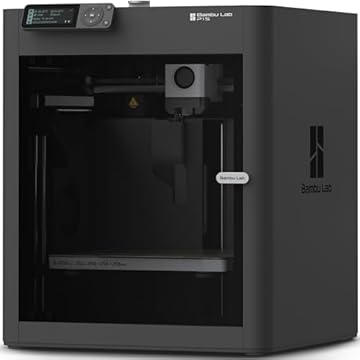
| MakerWorld Model Library | Multi-color plug-and-play workflows | Enclosed CoreXY chassis featuring an integrated AMS multi-color system and curated model library. |
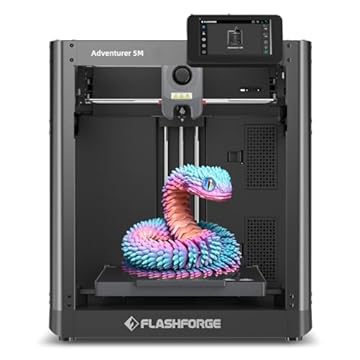
| FLASHFORGE Adventurer 5M 3D Printer | Compact desktop utility | Smaller 220x220x220mm build area, 600mm/s max speed, and a 280°C hotend with a 3-second detachable nozzle. |
| Beginner-Friendly Ecosystem with MakerWorld Model | Enclosed turnkey production | Factory-enclosed CoreXY structure tied directly to a turnkey software and model ecosystem. |
Choosing between these platforms comes down to your priorities regarding build volume and software freedom versus automated convenience. If you require an enclosed workspace out of the box with multi-filament switching, the MakerWorld Model Library platform provides an integrated multi-material ecosystem, though with a substantially smaller build volume. For tighter office spaces where rapid single-nozzle swappability on a 220mm square bed is sufficient, the FLASHFORGE Adventurer 5M 3D Printer offers a compact footprint and quick-change hardware. The Sovol SV08 remains the clear choice when massive single-piece capacity and unconstrained open-source firmware control are your non-negotiable requirements.

08 Bottom Line
When evaluating whether the is sovol sv08 worth it for your workshop, the answer hinges on your willingness to engage with an open-format mechanical platform. By translating the proven Voron 2.4 architecture into a semi-assembled, production-ready CoreXY machine, it offers a level of kinematic speed, thermal throughput, and build scale that is exceptionally rare in this category.
For engineers, makers, and production labs seeking an expansive physical canvas, the combination of 350x350x345mm build volume, Klipper input shaping, and quad-gantry leveling delivers serious manufacturing capability. It demands mechanical attentiveness, but it rewards operators with uncompromising performance and complete control over their hardware.
09 FAQ
How does the Sovol SV08 compare to building a custom Voron 2.4?
Evaluating the sovol sv08 vs voron 2.4 reveals distinct differences in time investment. Sourcing parts for a custom Voron 2.4 project requires purchasing dozens of individual components, printing structural ABS brackets on another machine, and wiring the entire electrical loom by hand, which often takes dozens of assembly hours. The Sovol SV08 delivers the foundational kinematic geometry, quad-gantry leveling, and CoreXY motion of the Voron 2.4 design in a pre-assembled metal frame, reducing setup time to hours rather than weeks while keeping the firmware and hardware open for custom modifications.
What makes quad gantry leveling essential on this machine?
On a large 350x350mm build surface, traditional two-point or single-lead-screw Z-axis designs struggle to keep the gantry perfectly level across the entire span. The quad-gantry system uses four independent stepper motors to actively adjust the orientation of the gantry relative to the bed. This eliminates physical gantry sagging and compensates for minor frame twisting, ensuring that the nozzle tracks parallel to the print surface across every square inch of the bed.
What slicer software works best with the Sovol SV08?
The printer is optimized for use with the open-source OrcaSlicer platform. OrcaSlicer natively supports the machine’s Klipper firmware, enabling sophisticated toolpath features like arc fitting, variable line widths, intelligent cooling parameters, and automated overhang speed control. Standard profiles within OrcaSlicer allow users to translate the printer’s high acceleration and volumetric flow capabilities directly into clean, dimensionally accurate parts.
How fast can the machine print functional parts?
While the machine’s kinematic hardware can achieve maximum velocities up to 700mm/s with 40000mm/s² acceleration during rapid travel moves, practical printing speeds for structural parts typically range between 200mm/s and 400mm/s depending on the filament material and geometry. The ceramic heating block and high-flow nozzle ensure that sufficient plastic is melted to sustain these high-speed toolpaths without under-extrusion.
What are the spatial and electrical requirements for the printer?
The unit measures 21 inches deep, 21.7 inches wide, and 22.6 inches high, with an overall weight of 39 pounds. It requires a rigid, stable work surface that will not sway during aggressive CoreXY directional shifts. Electrically, the printer utilizes an AC-powered heated bed that draws power directly to heat the build plate rapidly, requiring a standard, grounded mains outlet capable of supplying steady residential or workshop power.