As Amazon Associates, we earn from qualifying purchases. This means we may receive a small commission at no extra cost to you if you click through and make a purchase.

Managing electrical efficiency across a busy household or light commercial workspace requires granular telemetry rather than the passive estimates found on utility statements. Busy homeowners, system integrators, and facility managers frequently struggle to isolate continuous vampire draw, verify true appliance operating loads, or automate load-shedding sequences when main circuits face peak demand. The Shelly EM Gen3 addresses this diagnostic blind spot by providing compact, breaker-level single-phase energy tracking alongside integrated relay contactor switching. By operating right at the distribution board, the unit enables users to pinpoint abnormal power signatures and automate breaker actions without redesigning the entire electrical panel.
In our comprehensive Shelly EM Gen3 review, this hardware stands out as an exceptionally capable component for modern automation environments. Combining an upgraded 8MB processor with non-volatile local data retention and broad third-party network support, it delivers immediate insight into live wattage, cumulative consumption, and connected load health. While users seeking multi-circuit residential profiling might need to deploy multiple hardware units, the combination of dedicated clamp-based measurement and an onboard switching relay makes the Shelly EM Gen3 a remarkably decisive tool for focused electrical management.
01 Quick Verdict
The Shelly EM Gen3 delivers responsive single-phase monitoring and automated load handling directly at the breaker panel. With local logging that preserves telemetry through network dropouts, robust cloud-optional smart platform pairing, and a compact chassis built for tight enclosures, it is an efficient hardware solution for professionals wanting reliable power oversight.
- Local 10-day data logging at 1-minute intervals via an 8MB onboard chip
- Included 50A current transformer clamp for non-invasive single-phase load tracking
- Dedicated dry relay output for automated external contactor switching
- Broad integration with Home Assistant, Samsung SmartThings, Alexa, and Google Home
02 Shelly EM Gen3 Features Explained
01 8MB Shelly Chip and Local Telemetry Logging
At the center of the device is an upgraded 8MB Shelly chip engineered to handle high-frequency telemetry without bogging down local Wi-Fi networks. A persistent limitation with budget energy meters is their dependence on active cloud connections; if an internet service provider drops out, historical consumption records vanish or show severe gaps. The Shelly EM Gen3 eliminates this vulnerability by recording energy metrics locally into non-volatile memory for up to 10 days at 1-minute intervals. This rolling buffer guarantees that even during prolonged gateway or server outages, your circuit history remains intact.
Once network connectivity is restored, the unit syncs seamlessly with the Shelly Smart Control App or upstream management dashboards. For engineers and smart home managers who demand high data fidelity, having 1-minute resolution makes it possible to reconstruct operational profiles, evaluate compressor duty cycles, and conduct forensic reviews of unexpected power surges. This local processing autonomy makes the Shelly smart energy meter Gen3 a resilient upgrade over older generation monitoring units.
02 Contactor Control Relay and Automated Load Shedding
Beyond observation, the Shelly EM Gen3 provides actionable electrical management through its built-in contactor control relay. Operating as a normally open dry contact with a contact current rating of 50A and a rated switching capacity of 460 watts, this terminal allows users to orchestrate smart load shedding. Rather than routing massive multi-kilowatt branch currents directly across the internal printed circuit board, the Shelly EM Gen3 contactor control terminal acts as a trigger line to energize an external electrical contactor, safely cutting power to heavy appliances when circuit limits are approached.
Automated load management can be configured via internal scheduling, real-time consumption thresholds, or ecosystem scenes. When tied into smart infrastructure alongside devices like a schlage encode plus smart wi-fi deadbolt to determine home occupancy, the Shelly EM Gen3 can automatically disengage high-draw loads such as secondary water heaters, pool circulation pumps, or electric heaters when circuits reach predefined caps, safeguarding electrical distribution while actively trimming utility waste.
03 Smart Home Platform Compatibility and Ecosystem Pairing
Interoperability is a hallmark of the Shelly ecosystem, and the Gen3 iteration expands this flexibility across major consumer and professional smart platforms. The meter integrates natively with Amazon Alexa and Google Home for voice-driven status queries and basic switching, as well as Samsung SmartThings for unified domestic routines. For enthusiasts seeking deep automation logic, pairing the Shelly EM Gen3 Home Assistant integration provides local-polling REST API, MQTT, and WebSocket access that completely bypasses vendor servers, ensuring millisecond-level responsiveness.
Within Home Assistant, the device surfaces live power, voltage, accumulated kilowatt-hours, and relay status entities automatically. Users can pair these data streams with modular micro-relays like the shelly 1 gen4 to trigger granular secondary switching throughout a building. Whether configured through the vendor app or integrated into a private server dashboard, the device provides reliable data transport across mixed local and cloud environments.
04 Single-Phase Power Tracking and Appliance Health Monitoring
Utilizing an included 50A current transformer clamp, the Shelly EM Gen3 measures alternating current non-invasively by clipping around a single insulated conductor. This design allows users to deploy the Shelly EM Gen3 for power monitoring on dedicated branch lines feeding major HVAC components, electric vehicle chargers, or sub-panel feeds. Continuous line observation provides instant visibility into baseline idle draws, operating wattage, and power factor variations across different times of the day.
In addition to monitoring raw kilowatt-hour usage, the hardware acts as an early warning system for mechanical and electrical wear. Appliances containing inductive motors, like refrigeration compressors and sump pumps, exhibit recognizable electrical degradation curves before catastrophic failure occurs. By tracking sudden power spikes, lengthened run cycles, or voltage dropouts, the Shelly EM Gen3 alerts homeowners to abnormal equipment strain so maintenance can be scheduled before expensive equipment burns out.
03 Specs
| Attribute | Detail |
|---|---|
| Current Rating | 50 A |
| Contact Current Rating | 50 A |
| Connector Type | Clamp |
| Contact Type | Normally Open |
| Contact Material | Steel |
| Rated Wattage | 460 watts |
| Mounting Type | Wall Mount |
| Operation Mode | Automatic |
| Upper Temperature Rating | 105 °F |
| Module Weight | 23 g |
| Standards Met | CE, RoHS |
| Included Components | 1 x Shelly EM Gen3, 1 x 50A clamp, User manual |
| Manufacturer Warranty | 3 Years Manufacturer Warranty |
04 Shelly EM Gen3 Pros and Cons
Pros
- 10-day local logging at 1-minute intervals
- Contactor relay for automated load shedding
- Native integration with Home Assistant and Alexa
- Includes 50A current transformer clamp
- 3-year manufacturer warranty with professional support
Cons
- Single-phase electrical monitoring only
- External contactor hardware sold separately
- Listing does not specify DIN rail mount
05 Best Use Cases
- Tracking the primary incoming feed of a single-phase distribution panel to evaluate whole-system energy draw in real time.
- Observing heavy-draw mechanical equipment like heat pumps and compressors to detect anomalous electrical spikes before motor breakdown.
- Triggering an external contactor coil to automatically shed non-essential heating loads during periods of heavy electrical grid strain.
- Delivering local, cloud-independent telemetry directly to a Home Assistant server for automated domestic energy dashboards.
- Auditing individual branch sub-circuits to identify continuous phantom loads that inflate monthly facility operating costs.
06 Before You Buy
Before purchasing the Shelly EM Gen3, buyers must evaluate electrical panel compatibility and sizing requirements. The package includes a single Shelly EM Gen3 50A clamp designed strictly for single-phase electrical lines. If your monitoring target involves split-phase panels (standard in North American 120/240V residential panels that require dual CT clamps for balanced tracking) or three-phase commercial distribution, the listing does not include secondary clamps or larger-diameter transducers in this standard box. Furthermore, while the unit carries a contact current rating of 50A and 460 watts switching capacity, the listing does not include the physical external contactor hardware needed to break high-amperage equipment lines.
Physical enclosure planning is another crucial consideration. A review of the Shelly EM Gen3 specs shows a compact weight of 23 g and a wall mount classification, with steel terminal contacts and an upper temperature rating of 105 °F. However, the listing does not specify whether a snap-in DIN rail adapter bracket is bundled in the packaging, meaning you may need a separate holder if installing it inside a clean DIN-standard distribution panel. A proper Shelly EM Gen3 installation requires wiring direct line and neutral voltage inputs into the device terminals to power the internal circuitry and take voltage measurements; anyone uncomfortable working around live breaker buses should consult a licensed electrical professional.
07 How It Compares With Similar Picks
| Product | Best For | Key Difference |
|---|---|---|
| Shelly EM Gen3 | In-panel single-phase monitoring and automated contactor control | Compact breaker-box module with 50A CT clamp, 10-day local memory, and dry contact relay output |
| Upgraded Watt Power Meter Plug | Direct receptacle testing of standard 120V household appliances | External pass-through plug with 7 display modes and an integrated LCD backlight instead of panel wiring |
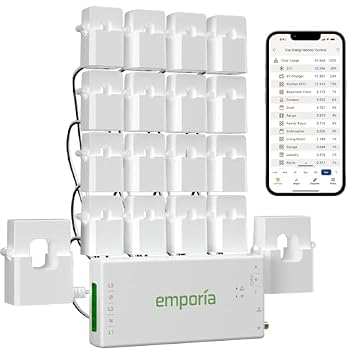
| Emporia Vue 3 Home Energy | Whole-home multi-branch panel monitoring and solar net metering | Multi-channel energy monitor with expanded sensor bundles and solar tracking rather than single-circuit relay control |
| HBN Watt Meter Plug | Benchtop analysis and quick outlet-level energy auditing | Plug-in socket tester featuring 9 display modes and digital screen without automation relays or network connectivity |
Selecting between these solutions depends on whether you require panel-level automation or simple point-of-use analysis. If you only want to check the draw of a tabletop tool or workshop equipment like a stahlwerk welder 4 in 1 multi tig without opening an electrical enclosure, the Upgraded Watt Power Meter Plug or HBN Watt Meter Plug provide direct plug-in simplicity on backlit displays. For homeowners requiring simultaneous tracking across dozens of individual circuit breakers alongside solar net metering, the Emporia Vue 3 Home Energy offers comprehensive multi-branch coverage. However, when you need compact in-panel telemetry linked directly to an automated contactor relay switch, the Shelly EM Gen3 remains the superior architectural choice.

08 Bottom Line
So, is Shelly EM Gen3 worth it for your energy management setup? For professionals and smart home operators needing decisive, local-first circuit monitoring, the answer is an emphatic yes. Its combination of an 8MB chip with 10-day offline logging, a responsive 50A current transformer clamp, and an automated contactor control relay gives you actionable control over high-draw branch lines that passive plug meters simply cannot match.
While multi-circuit panels will require either multiple modules or larger multi-channel monitoring systems, the Shelly EM Gen3 excels at its designated role: providing accurate, low-latency telemetry and load control for dedicated single-phase circuits. With its robust 3-year warranty, open ecosystem compatibility, and dependable engineering, it is an exceptional hardware investment for smarter electrical infrastructure.
09 FAQ
Does the Shelly EM Gen3 require a continuous internet connection to record data?
No, the Shelly EM Gen3 does not require an active cloud link to record electrical metrics. The module contains an 8MB onboard chip capable of saving up to 10 days of continuous energy data at 1-minute intervals locally. If your Wi-Fi or internet connection drops, the device retains the logged metrics in memory and synchronizes them once connectivity is restored.
Can the Shelly EM Gen3 switch heavy 50A loads directly through its relay?
Although the hardware lists a contact current rating of 50A, it features a rated switching wattage of 460 watts on its normally open dry contact. In practical installations, this internal relay is engineered to trigger the control coil of an external high-power contactor rather than handling massive inductive loads directly on its miniature internal terminals. The external contactor handles the heavy amperage switching safely.
What components are included in the standard Shelly EM Gen3 box?
According to the product specifications, the package includes one Shelly EM Gen3 unit, one 50A current transformer clamp, and a user manual. Additional accessories such as external contactors, extra clamps, or DIN rail brackets are not included in the standard box.
How does the Shelly EM Gen3 integrate with Home Assistant?
The Shelly EM Gen3 communicates seamlessly with Home Assistant over local Wi-Fi networks. It supports native Shelly integration, REST APIs, and MQTT messaging, allowing users to stream live wattage, voltage, cumulative kilowatt-hours, and relay state data directly to a local smart dashboard without routing traffic through third-party cloud servers.
What is the maximum operating temperature for the Shelly EM Gen3?
The device specifications state an upper temperature rating of 105 °F. When mounting the module inside an electrical service box or enclosed junction box, ensure that ambient heat buildup does not exceed this thermal limit to maintain measurement accuracy and long-term hardware reliability.