As Amazon Associates, we earn from qualifying purchases. This means we may receive a small commission at no extra cost to you if you click through and make a purchase.
As an Amazon Associate we earn from qualifying purchases. Links on this page are affiliate links.
Choosing between a rinnai vs GASLAND tankless water heater depends on your fuel source and installation needs. Both brands offer compact, on-demand heating for whole-house use. The Rinnai RX199iN supports both natural gas and propane, while the GASLAND CE686LP is propane-only. Rinnai also allows outdoor installation, whereas GASLAND is indoor-only. Flow rates differ significantly, with Rinnai providing higher capacity. These specs define which unit fits your home.
Fuel Type
Natural Gas, Propane
Propane
Max Flow Rate
11.1 GPM
7.6 GPM
Installation Location
Indoor, Outdoor
Indoor
Energy Efficiency Factor (UEF)
.98
0.8
Fixture Capacity
7 fixtures
not listed
Choose the first if
- You need a higher flow rate for multiple simultaneous fixtures
- You want the flexibility to use natural gas or propane
- You plan to install the unit in an outdoor location
Choose the second if
- You only have a propane supply available
- You are installing in a space-limited indoor area
- You prefer a lighter unit that weighs less
Verdict
Choose the Rinnai model if you need higher flow rates, dual-fuel flexibility, or outdoor installation options. The GASLAND unit is a suitable choice if you are strictly using propane and have limited indoor space. Your decision should hinge on your available fuel source and maximum hot water demand.
01 Rinnai vs GASLAND Tankless Comparison
Fuel flexibility
Edge: Rinnai 11.1 GPM Condensing Dual-Fuel Water Heater
You need to check your home’s gas supply before buying. The Rinnai RX199iN runs on both natural gas and propane. Its Smart Sense gas control system lets you choose either fuel source. This dual-fuel design gives you more options if you switch providers. The GASLAND CE686LP is propane-only. You must have a propane tank or line ready. If you rely on natural gas, the GASLAND unit will not work for you. Rinnai covers both bases. GASLAND limits you to one fuel type. This makes Rinnai the better choice for most households.
Flow rate capacity
Edge: Rinnai 11.1 GPM Condensing Dual-Fuel Water Heater
Your hot water flow depends on how many fixtures you use at once. Rinnai delivers up to 11.1 gallons per minute. This supports seven fixtures running simultaneously. You can shower, do laundry, and wash dishes without pressure drops. GASLAND provides 7.6 gallons per minute. This handles fewer fixtures at the same time. If you have a large family or multiple bathrooms, Rinnai’s higher output prevents cold shock. GASLAND works well for smaller homes or single-bathroom setups. The difference in flow rate is significant for high-demand households.
Installation location
Edge: Rinnai 11.1 GPM Condensing Dual-Fuel Water Heater
Where you place the unit matters for your home’s layout. Rinnai installs indoors or outdoors. Its Versa Vent design allows outdoor mounting with the RX-OVC vent cap. This frees up indoor closet space. GASLAND is indoor-only. You must mount it in a closet, basement, or laundry room. Outdoor installation is not supported for the GASLAND model. If you live in a cold climate, indoor placement protects the unit from freezing. However, if you want to save interior space, Rinnai offers outdoor flexibility that GASLAND lacks.
Physical dimensions
Edge: GASLAND 7.6 GPM Propane Tankless Water Heater
Space is limited in many utility areas. GASLAND is more compact. It measures 14.3 inches wide and 24.7 inches tall. It weighs 37.5 pounds. This fits easily into tight closets. Rinnai is larger. It measures 18.5 inches wide and 30.1 inches tall. It weighs 55 pounds. The Rinnai unit takes up more wall space and floor area. If you have a small mechanical room, GASLAND’s smaller footprint is easier to install. Rinnai’s size reflects its higher capacity, but you lose space to get it.
Energy efficiency
Edge: Rinnai 11.1 GPM Condensing Dual-Fuel Water Heater
Efficiency affects your long-term energy usage. Rinnai has a UEF of 0.98. This is the higher rating between the two units. GASLAND has a UEF of 0.80. Rinnai converts more heat into hot water with less waste. Higher efficiency means lower gas bills over time. Both units are tankless, which is more efficient than traditional tanks. However, Rinnai’s condensing technology pushes its efficiency higher. If you want to minimize gas consumption, Rinnai’s 0.98 UEF is the superior spec. GASLAND is efficient, but Rinnai is more so.
02 Which tankless water heater fits you
Homeowner needing high flow for multiple fixtures
Our pick: Rinnai 11.1 GPM Condensing Dual-Fuel Water Heater
The Rinnai RX199iN delivers 11.1 GPM and supports seven fixtures simultaneously. Its 199k BTU heating capacity ensures consistent hot water for whole-house use. This dual-fuel model runs on natural gas or propane, offering installation flexibility for indoor or outdoor placement. The compact 55-pound design fits standard spaces while providing superior flow rates compared to smaller units.
User with propane supply seeking compact indoor unit
Our pick: GASLAND 7.6 GPM Propane Tankless Water Heater
The GASLAND CE686LP is designed for propane use and indoor installation only. It offers 7.6 GPM with a 199k BTU capacity, suitable for whole-house needs. At 37.5 pounds, it is lighter and smaller than the Rinnai option. The black finish and CSA certification provide reliable safety standards for residential setups where natural gas is not available.
Buyer prioritizing energy efficiency and smart features
Our pick: Rinnai 11.1 GPM Condensing Dual-Fuel Water Heater
Rinnai achieves a UEF of 0.98, making it highly energy efficient. The Smart Sense gas control system optimizes performance across fuel types. While WiFi control requires a separate module, the unit includes an easy-to-use interface and Quick Flush feature for maintenance. The 15-year heat exchanger warranty offers long-term protection for your investment compared to standard industry terms.

Rinnai 11.1 GPM Condensing Dual-Fuel Water Heater
Best for: large households needing high flow
- Fuel Type
- Natural Gas, Propane
- Max Flow Rate
- 11.1 GPM
- Heating Capacity
- 199k BTU
- Installation Location
- Indoor, Outdoor
- Fixture Capacity
- 7 fixtures
- Features
- Tankless
The Rinnai RX199iN delivers 11.1 GPM of hot water using 199k BTU of heating capacity. It supports both natural gas and propane, allowing flexible fuel choices. The unit handles up to seven fixtures simultaneously and fits in compact spaces at 18.5 inches wide. Its condensing design achieves a high UEF of .98. You get indoor or outdoor installation options with Smart Sense technology for gas control.
- 11.1 GPM max flow rate
- 199k BTU heating capacity
- Supports natural gas and propane
- Handles 7 fixtures at once
- Indoor or outdoor installation
- Heavier at 55 pounds
- Requires separate Controlr module for WiFi
- You need hot water for multiple bathrooms
- You want indoor or outdoor flexibility
- You prefer natural gas or propane fuel
- You want built-in WiFi connectivity
- You prefer a lighter unit under 50 pounds
- You only have electric wiring available
Verdict: Rinnai RX199iN 11.1 GPM Tankless Heater suits large households needing high flow rates for multiple simultaneous uses. It offers versatile fuel and placement options for robust performance.
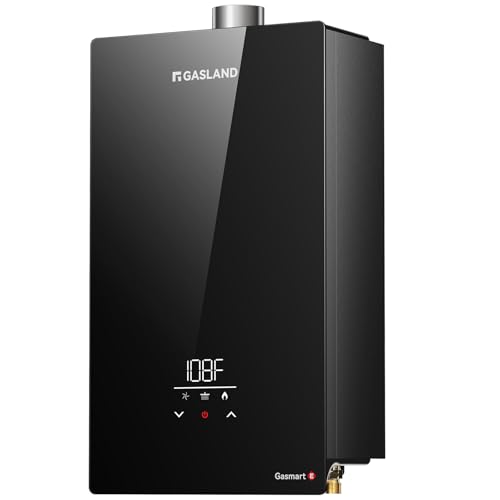
GASLAND 7.6 GPM Propane Tankless Water Heater
Best for: Indoor propane whole-house hot water
- Fuel Type
- Propane
- Max Flow Rate
- 7.6 GPM
- Heating Capacity
- 199000 BTU
- Installation Location
- Indoor
- Installation Type
- Whole House
- Features
- Tankless
The GASLAND Gasmart E is an indoor propane tankless water heater designed for whole-house use. It delivers a maximum flow rate of 7.6 GPM with 199,000 BTU of heating capacity. The unit measures 14.3 by 24.7 inches and weighs 37.5 pounds. Its compact, wall-mounted design saves space in closets or laundry rooms. This model suits households seeking continuous hot water with efficient propane operation.
- Provides unlimited hot water on demand with a 7.6 GPM flow rate.
- High energy efficiency with a UEF of 0.8.
- Compact suitcase-sized design fits in small indoor spaces.
- Includes safety features like overheat and freeze protection.
- Lower maximum flow rate of 7.6 GPM compared to the Rinnai RX199iN's 11.1 GPM.
- Heavier build at 37.5 pounds, which may complicate installation.
- Indoor-only installation limits placement options compared to outdoor models.
- You need a compact, wall-mounted unit for indoor propane heating.
- You want a whole-house solution with high energy efficiency.
- You prioritize safety certifications like CSA approval.
- You require a flow rate higher than 7.6 GPM.
- You need an outdoor-rated water heater.
- You prefer a lighter unit for easier DIY installation.
Verdict: The GASLAND Gasmart E 7.6 GPM Propane Heater offers reliable whole-house hot water with high efficiency. It fits well in homes with propane lines and limited indoor space, provided you do not need the higher flow rate of larger competitors.
03 Specifications side by side
| Spec | Rinnai 11.1 GPM Condensing Dual-Fuel Water Heater | GASLAND 7.6 GPM Propane Tankless Water Heater |
|---|---|---|
| Fuel Type | Natural Gas, Propane | Propane |
| Max Flow Rate | 11.1 GPM | 7.6 GPM |
| Heating Capacity | 199k BTU | 199000 BTU |
| Installation Location | Indoor, Outdoor | Indoor |
| Fixture Capacity | 7 fixtures | – |
| Installation Type | – | Whole House |
| Features | Tankless | Tankless |
| Dimensions | 30.1 × 18.5 × 30.1 inches | 14.3 × 14.3 × 24.7 inches |
| Weight | 55 pounds | 37.5 pounds |
| Size | 11.1 GPM | 7.6 GPM |
| Color | Silver | Black |
| Model | RX199iN | CE686LP |
04 Frequently asked questions
Is Rinnai better than GASLAND for large families?
Rinnai is the better choice for large families needing high flow. The RX199iN model delivers 11.1 GPM, supporting up to seven fixtures simultaneously. This capacity ensures consistent hot water for whole-house use during peak times. GASLAND offers a lower 7.6 GPM rate, which may suffice for smaller homes but struggles with multiple simultaneous uses.
Can I install these units outdoors?
You can install the Rinnai RX199iN outdoors. Its design allows for exterior placement, providing flexibility in where you place the unit. The GASLAND CE686LP is intended for indoor installation only. You must check your specific model’s manual to confirm placement requirements, as outdoor exposure can damage indoor-rated components.
Does GASLAND work with natural gas?
No, the GASLAND CE686LP runs on propane only. It is not compatible with natural gas lines. In contrast, the Rinnai RX199iN is a dual-fuel unit. It can operate on either natural gas or propane, giving you more flexibility if your home’s fuel source changes or if you have mixed availability.
Which heater is smaller and lighter?
The GASLAND CE686LP is smaller and lighter. It measures 14.3 inches wide and 24.7 inches tall, weighing 37.5 pounds. The Rinnai RX199iN is larger, measuring 18.5 inches wide and 30.1 inches tall, with a weight of 55 pounds. If you have limited space, the GASLAND unit fits more easily in tight areas.
What is the difference in flow rate between the two?
The Rinnai RX199iN has a higher flow rate of 11.1 GPM compared to the GASLAND CE686LP at 7.6 GPM. This 3.5 GPM difference means Rinnai can supply more hot water at once. You should choose Rinnai if you run multiple showers or appliances simultaneously to avoid temperature fluctuations or pressure drops.
Do I need a special vent for the Rinnai?
The Rinnai RX199iN is a condensing unit, which often requires specific venting materials like PVC or CPVC. You must verify the installation manual for exact venting specifications. The GASLAND CE686LP is also a tankless unit but is designed for indoor use. Always follow manufacturer guidelines for safe and efficient exhaust ventilation.
Is Rinnai worth the extra space and weight?
Rinnai is worth the extra size if you prioritize flow rate and fuel flexibility. The RX199iN offers 11.1 GPM and dual-fuel capability, making it robust for demanding households. If space is tight or you only need propane, the smaller GASLAND unit is sufficient. Weigh your hot water needs against available installation space.


