As Amazon Associates, we earn from qualifying purchases. This means we may receive a small commission at no extra cost to you if you click through and make a purchase.
As an Amazon Associate we earn from qualifying purchases. Links on this page are affiliate links.
In this rheem vs westinghouse tankless water heater comparison, you look at two electric units for whole-home use. Both operate on 240V power and deliver on-demand hot water without a storage tank. The main difference lies in their heating capacity and flow rates. Rheem offers 18kW with a 4.4 GPM max, while Westinghouse provides 24kW and up to 5.55 GPM. You also get smart features with Westinghouse, whereas Rheem focuses on precise digital control.
Heating Capacity
18kW
24kW
Max Flow Rate
up to 4.4 GPM
5.55 GPM
Smart Features
Digital thermostat with LED display
WiFi with Alexa and Google Home support
Temperature Range
Adjustable via digital control
86-140℉
Dimensions (H x W x D)
3.5 x 14.5 x 18.5 inches
17.1 x 13 x 13 inches
Weight
14.8 pounds
17 pounds
Choose the first if
- You prefer a lighter unit that is easier to mount.
- You want precise temperature adjustments with a simple digital interface.
- Your household has moderate hot water needs under 4.4 GPM.
Choose the second if
- You need higher flow rates for simultaneous shower and sink use.
- You want to control water temperature remotely via a smartphone app.
- Your electrical panel can support the higher 100A breaker requirement.
Verdict
Choose the Rheem if you prioritize a compact, lightweight design and straightforward digital control for smaller households. Pick the Westinghouse if you need higher flow capacity and smart home integration for larger families. Both units effectively deliver endless hot water for residential use.
01 Rheem vs Westinghouse Tankless Specs
Heating capacity
Edge: Westinghouse 24kW WiFi Tankless Water Heater
The Rheem model provides 18kW of heating power, while the Westinghouse unit delivers 24kW. Higher wattage generally supports greater flow rates and temperature rise. The Westinghouse 24kW rating suggests it can handle more simultaneous demands or colder inlet water. Rheem relies on a lower 18kW output. This difference is significant for whole-home applications where peak usage matters. You should consider your local groundwater temperature and typical household size when weighing this spec.
Flow rate
Edge: Westinghouse 24kW WiFi Tankless Water Heater
Westinghouse lists a maximum flow rate of up to 5.55 GPM. Rheem specifies a maximum flow of up to 4.4 GPM. The higher GPM on the Westinghouse unit means you can run more fixtures at once without pressure drops. Rheem’s 4.4 GPM is sufficient for a bathroom and kitchen but may struggle with multiple showers. If your household has high simultaneous demand, the Westinghouse flow spec offers more headroom. Rheem remains adequate for smaller setups.
Smart features
Edge: Westinghouse 24kW WiFi Tankless Water Heater
Westinghouse includes built-in Wi-Fi connectivity for remote control via an app or voice assistants like Alexa and Google Home. Rheem features an external digital thermostatic control with an LED display but does not list Wi-Fi or app integration in its specifications. The Westinghouse smart capabilities allow you to adjust settings from a distance. Rheem requires physical interaction with the unit for temperature changes. If remote monitoring is a priority, Westinghouse has the clear advantage.
Dimensions
Edge: Rheem 18kW 240V Electric Tankless Water Heater
Rheem measures 18.5 inches in length, 14.5 inches in width, and 3.5 inches in height. Westinghouse measures 17.1 inches in height, 13 inches in width, and 13 inches in length. Rheem is flatter and wider, while Westinghouse is taller and narrower. Both are compact enough for wall mounting. Rheem’s 3.5-inch depth is very slim. Westinghouse’s 13-inch depth is deeper. Installation space requirements differ, so measure your available wall area before choosing.
Temperature control
Edge: Rheem 18kW 240V Electric Tankless Water Heater
Rheem offers an external digital thermostatic control with plus or minus 1 degree accuracy. Westinghouse provides a temperature range of 86 to 140 degrees Fahrenheit but does not specify control precision. Rheem’s explicit accuracy rating allows for fine-tuning. Westinghouse’s wide range ensures hot water is available, but you lack precision data. Rheem’s digital display shows exact settings. Westinghouse relies on its smart app for adjustments. Rheem wins on stated control precision.
02 Which Tankless Water Heater Fits Your Needs?
You want smart home integration and voice control
Our pick: Westinghouse 24kW WiFi Tankless Water Heater
The Westinghouse unit includes built-in Wi-Fi connectivity, allowing you to adjust settings remotely via an app or use voice commands with Alexa and Google Home. This feature supports modern smart home setups, letting you monitor usage and change temperatures from anywhere, which the Rheem model does not offer in its specifications.
You prefer precise temperature control with high accuracy
Our pick: Rheem 18kW 240V Electric Tankless Water Heater
The Rheem model features an external digital thermostatic control with an LED display that provides plus or minus one degree accuracy. This level of precision allows you to set exact water temperatures. The unit also uses self-modulation technology to adjust power based on demand, ensuring consistent heat output without the need for app-based adjustments.
You need the highest possible flow rate for multiple fixtures
Our pick: Westinghouse 24kW WiFi Tankless Water Heater
With a 24kW heating capacity, the Westinghouse heater supports a maximum flow rate of 5.55 GPM. This higher output is suitable for running a shower and sink simultaneously. The Rheem unit tops out at 4.4 GPM due to its 18kW capacity. If you require more simultaneous hot water, the Westinghouse spec provides a clear advantage.
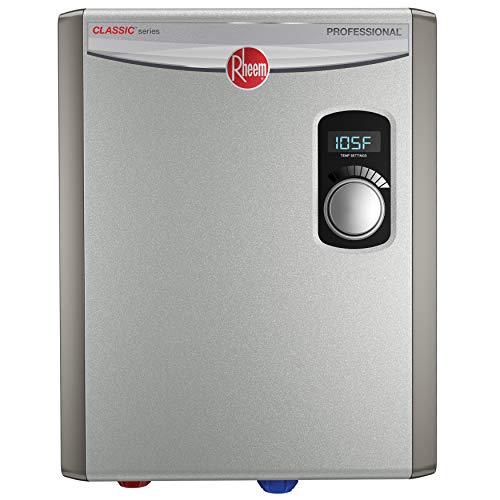
Rheem 18kW 240V Electric Tankless Water Heater
Best for: Whole-home electric hot water needs
- Fuel Type
- Electric
- Max Flow Rate
- up to 4.4 GPM
- Heating Capacity
- 18kW
- Voltage
- 240V
- Features
- Tankless
- Wattage
- 18 kW
This Rheem unit is an 18kW electric tankless water heater designed for whole-home use. It delivers a maximum flow rate of up to 4.4 GPM. The device features external digital thermostatic control with LED display for precise temperature adjustment. Its compact dimensions of 18.5 inches by 14.5 inches by 3.5 inches allow for easy installation. The copper immersion heating elements are field serviceable. This model suits households needing reliable hot water with simple maintenance access.
- 18kW heating capacity for consistent hot water
- Maximum flow rate of up to 4.4 GPM
- External digital thermostatic control with LED display
- Durable copper immersion two heating elements
- Compact size of 14.5 inches wide and 3.5 inches high
- 18kW power is lower than the 24kW Westinghouse option
- Maximum flow rate of 4.4 GPM is lower than the 24kW competitor
- Weight of 14.8 pounds adds bulk compared to lighter models
- You need a compact electric water heater for a whole home
- You want field-serviceable copper heating elements for long-term durability
- You prefer digital temperature control with plus or minus 1 degree accuracy
- You require a higher flow rate than 4.4 GPM
- You need more than 18kW of heating power
- You prefer a unit with a larger maximum capacity
Verdict: Rheem 18kW Electric Tankless Heater offers reliable performance for households with moderate hot water demands. Its compact design and serviceable elements make it a solid choice for standard whole-home applications.
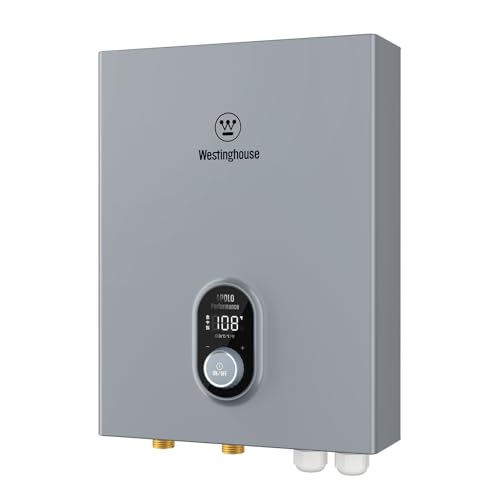
Westinghouse 24kW WiFi Tankless Water Heater
Best for: Whole-house hot water with WiFi control
- Fuel Type
- Electric
- Max Flow Rate
- 5.55 GPM
- Heating Capacity
- 24 kW
- Voltage
- 240 V
- Fixture Capacity
- Shower and sink
- Installation Type
- Whole House
This 24kW 240V unit delivers up to 5.55 GPM of instant hot water. It supports a shower and sink simultaneously. Smart WiFi lets you adjust temperature remotely. The compact 17.1-inch height saves space. You get precise control over water heating. It suits whole-house residential needs efficiently.
- 24kW heating capacity for strong flow
- Max 5.55 GPM output rate
- WiFi remote temperature control
- Compact 17.1 x 13 x 13 inch size
- Requires 100A electrical service capacity
- Limited to 240V power connection only
- Max temperature range capped at 140°F
- You need whole-house hot water supply
- You have 240V electrical infrastructure ready
- You want remote WiFi temperature adjustments
- Your electrical panel lacks 100A breaker capacity
- You require gas fuel type alternatives
- You need higher than 140°F water temps
Verdict: Westinghouse 24kW WiFi Electric Tankless fits homes with robust 240V wiring seeking high flow. It delivers reliable hot water for multiple fixtures. Smart features add convenience for modern households.
03 Specifications side by side
| Spec | Rheem 18kW 240V Electric Tankless Water Heater | Westinghouse 24kW WiFi Tankless Water Heater |
|---|---|---|
| Fuel Type | Electric | Electric |
| Max Flow Rate | up to 4.4 GPM | 5.55 GPM |
| Heating Capacity | 18kW | 24 kW |
| Voltage | 240V | 240 V |
| Fixture Capacity | – | Shower and sink |
| Installation Type | – | Whole House |
| Features | Tankless | Tankless |
| Application | – | Bathroom |
| Wattage | 18 kW | – |
| Intended Use | Home | Home |
| Dimensions | 18.5 × 14.5 × 3.5 inches | 13 × 13 × 17.1 inches |
| Weight | 14.8 pounds | 17 pounds |
| Size | Small | L-24 |
| Color | Gray | Gray 24 |
| Model | RTEX-18 | WET-24K-G |
04 Frequently asked questions
Which tankless water heater has the smallest footprint?
The Rheem model features a smaller physical size than the Westinghouse unit. It measures 14.5 inches wide and 18.5 inches long. The Westinghouse unit is 13 inches wide and 13 inches long but stands taller at 17.1 inches. You should check your installation space carefully. Both units are compact, but their dimensions differ in shape and height.
Does the Westinghouse heater offer smart home connectivity?
Yes, the Westinghouse 24kW unit includes built-in Wi-Fi connectivity. This allows you to control the heater remotely through an app or voice commands. The Rheem 18kW model does not list smart features in its specifications. If remote monitoring is a priority for your home setup, the Westinghouse option provides that capability.
What is the difference in heating power between these two?
The Westinghouse heater delivers 24kW of power, while the Rheem unit provides 18kW. Higher wattage generally supports greater flow rates and temperature rise. The Westinghouse 24kW rating suggests it can handle more simultaneous demands or colder inlet water temperatures. You should choose the higher wattage unit if you have multiple fixtures running at once.
Are both units suitable for whole-home use?
Yes, both heaters are designed for whole-home applications. The Rheem model is intended for standard whole-home electric hot water needs. The Westinghouse unit is also marketed for whole-house hot water. Both operate on 240V power. You can install either unit to serve your entire household, depending on your specific flow rate requirements.
How much does each tankless water heater weigh?
The Rheem unit weighs 14.8 pounds. The Westinghouse model weighs 17 pounds. Both units are relatively lightweight for tankless heaters. This makes them easier to mount on a wall. You should ensure your wall can support the weight, though both are light enough for standard residential mounting.
Which heater is better for moderate hot water demands?
The Rheem 18kW model is described as a solid choice for standard whole-home applications with moderate demands. Its compact design and serviceable elements support reliable performance. The Westinghouse unit offers higher power, which may be overkill for moderate needs. If your usage is average, the Rheem 18kW unit meets the requirement efficiently.
Do these tankless heaters use gas or electricity?
Both units are electric tankless water heaters. The Rheem model operates on 240V electricity. The Westinghouse unit also requires 240V power. Neither unit uses gas. You must have appropriate electrical wiring in your home to install either of these models. Ensure your electrical panel can handle the load for your chosen wattage.


