As Amazon Associates, we earn from qualifying purchases. This means we may receive a small commission at no extra cost to you if you click through and make a purchase.

Remote professionals frequently struggle with dropped video conferences, unstable bandwidth, and dead zones caused by thick walls and distributed home office layouts. When multiple household members stream media, attend virtual meetings, and download large files simultaneously, standard single-unit routers quickly buckle under network congestion. The Linksys Atlas Pro 6 is engineered specifically to eliminate these dead spots and deliver uniform, wire-like wireless stability across medium-to-large multi-room residences.
In this Linksys MX5503 review, we evaluate whether this dual-band mesh architecture provides the sustained throughput and low-latency performance necessary for critical business workflows. Operating on the Qualcomm Immersive Home 216 Platform with native support for 160 MHz channels, this Linksys MX5503 WiFi 6 mesh package offers a decisive balance of wide wireless reach, four Gigabit ports per unit, and reliable multi-device handling. For busy remote workers seeking dependable whole-home connectivity without enterprise configuration complexity, it stands as a focused, highly practical mesh solution.
01 Quick Verdict
The Linksys Atlas Pro 6 provides a robust, no-nonsense mesh networking foundation tailored for remote workers and busy households needing stable, drop-free connectivity. By combining modern 802.11ax technology with intelligent mesh management, it resolves the coverage gaps and packet loss that typically disrupt home office productivity.
- Qualcomm Immersive Home 216 Platform ensures consistent multi-device processing and stable data routing.
- Support for ultra-wide 160 MHz channels delivers maximum throughput to compatible client devices.
- Four physical Gigabit Ethernet ports on every node facilitate flexible wired connections for desktop workstations.
- Velop Intelligent Mesh system dynamically optimizes client connections across all three modular nodes.
02 Linksys Atlas Pro 6 Features Explained
01 Qualcomm Immersive Home 216 Platform
At the center of each mesh unit sits the Qualcomm Immersive Home 216 Platform, a dedicated silicon foundation architected to deliver wire-like stability across wireless environments. Mesh networks frequently falter when dozens of simultaneous data streams compete for memory and processor cycles, leading to micro-stutters during voice-over-IP and corporate video presentations. By utilizing this specialized processing architecture, the router maintains precise packet scheduling and sustained device coordination even under intense household demand.
For individuals establishing a dedicated Linksys Atlas Pro 6 for home office productivity, hardware-level processing stability is essential. Professionals comparing modular wireless architectures might also inspect commercial-grade gear like the Ubiquiti UniFi U6 Pro to see whether standalone access points or consumer mesh systems better match their physical cabling layout. Within a consumer-friendly mesh framework, the Qualcomm platform provides the necessary compute headroom to ensure background downloads or video streaming in other rooms do not compromise active business calls.
02 Velop Intelligent Mesh Technology
Coverage dead zones and sluggish handoffs between rooms present persistent frustrations for mobile laptop users. The Linksys Velop Intelligent Mesh system continuously monitors network conditions, dynamically routing wireless traffic along the cleanest path back to your primary broadband connection. As you move between your desk, common areas, or patio spaces, the system executes seamless client roaming, preventing connection drops during live conference sessions.
The system operates as a cohesive unit where additional nodes reinforce the coverage fabric rather than degrading signal purity. Five internal antennas per node broadcast omnidirectional radio waves shaped to penetrate architectural obstacles and eliminate dead corners. Because the intelligent routing algorithms adapt to changing radio frequency conditions in real time, the network automatically self-heals if a secondary node experiences localized physical interference.
03 160 MHz Channels and Dynamic Frequency Selection
The defining capability of this Linksys 160 MHz mesh router is its access to ultrawide 160 MHz channel bandwidth on the 5 GHz spectrum. Standard routers often restrict client devices to 80 MHz or narrower channels, cutting theoretical maximum throughput in half. Unlocking true 160 MHz operation allows compatible laptops and workstations to double their wireless data transfer rates, mirroring the speed and immediacy of direct wired links.
Operating on expansive channel widths in suburban environments can occasionally cause conflicts with nearby radar equipment and neighboring routers. The Linksys Atlas Pro 6 incorporates Dynamic Frequency Selection (DFS), allowing the system to monitor and access clearer, less congested radar channels legally and automatically. By navigating away from crowded frequencies, DFS minimizes interference and preserves pristine signal fidelity for uninterrupted corporate video calls.
04 Gigabit Wired Connectivity and Network Security
Each individual node within the Linksys Atlas Pro 6 3-pack features four Gigabit Ethernet ports, offering four physical wired connections per unit. Many modern mesh systems reduce manufacturing costs by including only one or two network ports, forcing users to buy supplementary network switches. Having four dedicated 1000 Mbps ports on each node allows home office workers to plug in desktop computers, network-attached storage, docking stations, and network printers directly.
Managing the network is streamlined through the dedicated mobile app alongside standard Wi-Fi Protected Setup (WPS) pairing. From a defensive perspective, the system incorporates an integrated SPI firewall and provides modern encryption standards, supporting both WPA2 Personal and robust WPA3 Personal protocols. This ensures your corporate data, client correspondence, and smart home hardware remain guarded against unauthorized external interception.
03 Specs
| Specification | Detail |
|---|---|
| Wi-Fi Standard | Wi-Fi 6 (802.11ax) |
| Frequency Band Class | Dual-Band |
| Processor Architecture | Qualcomm Immersive Home 216 Platform |
| Channel Width Support | Up to 160 MHz with DFS |
| Antenna Configuration | 5 Internal Antennas per Node |
| Ethernet Ports | 4 Gigabit LAN Ports per Unit (1000 Mbps) |
| Maximum Upstream Rate | 1000 megabits per second |
| Security Encryption | WPA2 Personal, WPA3 Personal |
| Integrated Firewall | True (Hardware Firewall Enabled) |
| Management & Setup | Linksys Mobile App, WPS Hardware Support |
04 Linksys Atlas Pro 6 Pros and Cons
Pros
- Support for wide 160 MHz channels
- Qualcomm Immersive Home 216 Platform
- Four Gigabit LAN ports per node
- WPA3 Personal security encryption
- Dynamic Frequency Selection radar avoidance
Cons
- Dual-band design lacks dedicated third backhaul
- LAN ports capped at 1000 Mbps bandwidth
05 Best Use Cases
- Equipping multi-level homes with seamless, whole-property wireless roaming to prevent call drops during video conferences.
- Providing dedicated home office workstations with high-speed wired access through four Gigabit Ethernet ports on nearby satellite nodes.
- Transmitting dense data payloads and uncompressed media across client laptops via ultra-wide 160 MHz channel capability.
- Eliminating localized Wi-Fi dead zones and structural signal degradation across sprawling residential living spaces.
06 Before You Buy
Before purchasing the Linksys Atlas Pro 6, it is important to understand its architectural configuration and operational design. This package is a dual-band mesh system, meaning it shares its 5 GHz frequency band between client data traffic and wireless inter-node communication. In households with exceptionally high local traffic demands, running a physical cable between units to leverage Linksys Atlas Pro 6 Ethernet backhaul guarantees maximum speeds at remote satellite nodes, freeing up wireless airtime entirely for client devices. If your property demands dedicated multi-band backhaul or next-generation standards, evaluating systems like the Netgear Orbi 770 can clarify whether moving to multi-gigabit wireless backbones is justified.
Regarding compatibility and physical packaging, the listing specifies a complete three-pack bundle powered by Linux operating software, designed for straightforward mobile app setup with built-in WPS capabilities. However, prospective buyers should note what the listing does not include or specify. The listing does not specify exact square footage coverage figures, nor does it list USB expansion ports for external hard drive sharing. Furthermore, its Ethernet ports are rated for standard Gigabit bandwidth at 1000 Mbps, meaning it does not support multi-gigabit broadband subscriptions exceeding 1 Gbps.
07 How It Compares With Similar Picks
| Product | Best For | Key Difference |
|---|---|---|
| Linksys Atlas Pro 6 | Home offices needing 160 MHz throughput and 4 Gigabit ports per node | Dual-band Wi-Fi 6 with Qualcomm 216 platform and 4 LAN ports per unit |
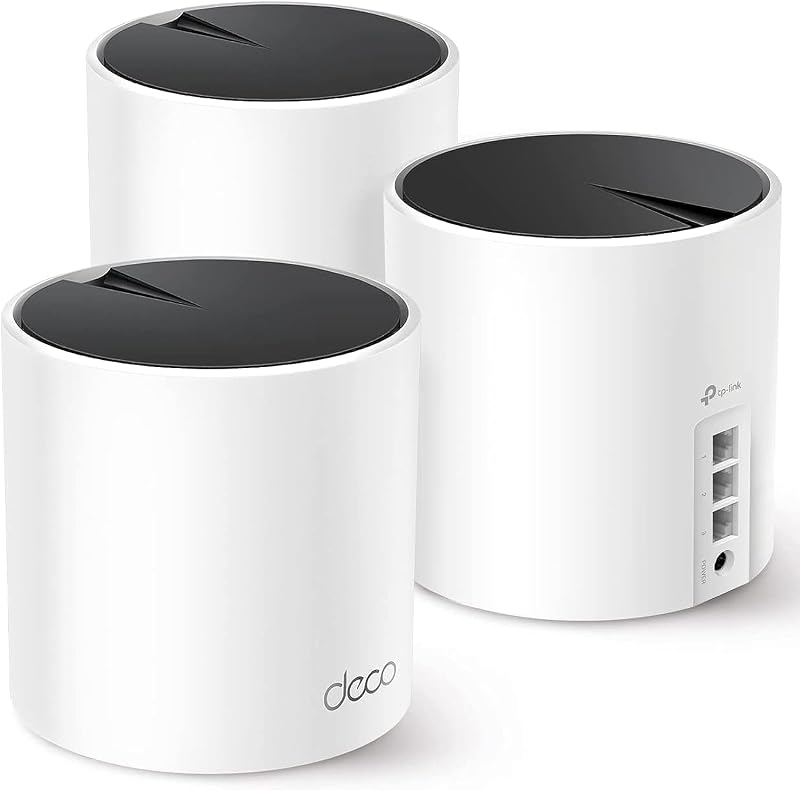
| TP-Link Deco X55 | Budget-conscious coverage up to 6500 sq ft | Dual-band Wi-Fi 6 with 3 Gigabit ports per unit and Ethernet backhaul |
| TP-Link Deco BE25 | Entry Wi-Fi 7 networks up to 6600 sq ft | Dual-band Wi-Fi 7 BE5000 with 2x 2.5G ports and 240 MHz channel support |
| TP-Link Deco BE63 | High-bandwidth households up to 7600 sq ft | Tri-band Wi-Fi 7 BE10000 with 4x 2.5G ports and 6-stream 10 Gbps capability |
Choosing between these systems depends largely on your physical wiring and broadband speeds. Shoppers prioritizing budget-friendly, large-scale residential coverage can consider the TP-Link Deco X55 AX3000 WiFi 6 Mesh System, which offers three Gigabit ports per node and covers up to 6500 square feet. Users who subscribe to multi-gigabit internet tiers will benefit more from next-generation alternatives, such as the TP-Link Deco BE25 BE5000 WiFi 7 Mesh System with its 2.5G ports and 240 MHz channels, or the powerhouse TP-Link Deco BE63 BE10000 Whole Home Mesh System, which features tri-band capability and four 2.5G ports per node to handle up to 7600 square feet of demanding connected environments.
08 Bottom Line
The Linksys Atlas Pro 6 represents a well-engineered mesh networking investment for professionals working remotely who demand dependable wireless signal strength and low-latency meeting stability. While multi-gigabit enthusiasts and power users running high-capacity network storage may miss multi-gigabit ports or a dedicated third backhaul band, the core Qualcomm Immersive Home 216 hardware delivers remarkable consistency for everyday enterprise applications.
When considering whether the Linksys Atlas Pro 6 is worth it, the answer is clear for households with standard Gigabit internet subscriptions. With four Gigabit Ethernet ports on each modular node, expansive 160 MHz channel capability, and intelligent dynamic routing via Velop mesh technology, this three-pack package efficiently eliminates domestic wireless dead zones and guarantees smooth, productive daily workflow.
09 FAQ
Is the Linksys Atlas Pro 6 dual-band or tri-band?
The Linksys Atlas Pro 6 is a dual-band Wi-Fi 6 mesh system. It operates across standard 2.4 GHz and high-speed 5 GHz wireless frequencies, utilizing dynamic channel selection and 160 MHz wide channels to maintain high client throughput without requiring a dedicated third wireless radio band.
Can you connect Ethernet backhaul to the Linksys Atlas Pro 6 nodes?
Yes, each node includes four Gigabit Ethernet ports rated at 1000 Mbps bandwidth. Users can connect satellite nodes back to the parent router via standard Ethernet cabling, providing a dedicated wired backhaul that bypasses wireless transmission barriers and delivers maximum throughput throughout large homes.
Does the Linksys Atlas Pro 6 support WPA3 security encryption?
Yes, the system supports both WPA2 Personal and WPA3 Personal security encryption standards. It also features an integrated True hardware firewall to protect connected client devices, laptops, and home office systems from malicious external intrusion.
How many Ethernet ports does each Linksys Atlas Pro 6 node provide?
Each individual unit features four 1000 Mbps Gigabit Ethernet ports. In a standard three-pack installation, this provides a total of twelve Gigabit ports distributed across your living or office space, making it easy to wire printers, desktop towers, and gaming consoles without extra switches.
What makes 160 MHz channels advantageous on this mesh router?
Access to 160 MHz channels doubles the available bandwidth compared to standard 80 MHz channel widths found on conventional consumer routers. This allows compatible client laptops and mobile devices to achieve faster upload and download rates with minimal packet latency, ideal for large data transfers and uninterrupted virtual meetings.