As Amazon Associates, we earn from qualifying purchases. This means we may receive a small commission at no extra cost to you if you click through and make a purchase.

Bridging legacy analog hardware with modern cloud communications often creates an operational challenge for IT managers, telecom engineers, and office administrators. Analog telephone adapters must convert traditional two-wire POTS signaling into clean digital voice packets without introducing jitter, dropped calls, or security vulnerabilities into the corporate network. The Grandstream HT802 V2 is engineered to resolve this transition by serving as a dedicated multi-line bridge connecting legacy handsets, paging equipment, and physical fax hardware directly into hosted SIP platforms and on-premise IP PBXs.
Our verdict is decisive: for enterprise environments and branch offices requiring dependable analog migration, this adapter provides an enterprise-ready combination of encrypted communication protocols, automated mass provisioning, and robust T.38 fax reliability. It streamlines infrastructure upgrades while preserving existing capital investments in analog terminal devices.
01 Quick Verdict
This comprehensive Grandstream HT802 V2 review confirms that the adapter delivers dependable enterprise telephony integration across dual analog lines while maintaining rigorous transport security standards.
- Dual FXS ports supporting two independent SIP profiles for line-level isolation.
- Robust transport security featuring TLS signaling and SRTP media stream encryption.
- Dedicated T.38 fax over IP protocol support for legacy physical fax terminal continuity.
- Automated mass provisioning using TR-069 and standard XML configuration templates.
02 Grandstream HT802 V2 Features Explained
01 Dual FXS Port Architecture and Independent SIP Profiles
The core capability of this HT802 V2 2 FXS port ATA rests in its dual RJ-11 analog interfaces backed by a single 10/100Mbps Ethernet uplink. Unlike consumer adapters that mirror a single registration across both jacks, this unit supports two entirely independent SIP profiles. Telephony administrators can register each physical port to a separate PBX server, extension number, or SIP service provider, establishing total operational segregation between lines.
Deploying the Grandstream HT802 V2 for office environments allows an organization to service an executive analog desk phone on line one while dedicating line two to a shared reception desk, physical paging system, or hallway courtesy phone. Each channel operates independently with full multi-line operation and native three-way voice conferencing capability, ensuring clear audio transmission without channel crosstalk or packet contention.
02 Enterprise Signaling and Media Security
Transmitting voice over public broadband connections introduces substantial interception risks, making Grandstream HT802 V2 SIP security an indispensable component for corporate deployments. The hardware incorporates TLS (Transport Layer Security) encryption to protect SIP signaling packets, safeguarding user credentials, registration authentications, and call control metadata from external tampering.
To defend active voice conversations, the adapter applies SRTP (Secure Real-Time Transport Protocol) encryption to all media packets. This dual-layer defensive posture prevents eavesdropping on sensitive voice calls, providing corporate, financial, and healthcare administrators with the protocol-level compliance required for distributed VoIP endpoints.
03 Automated Device Provisioning and Centralized Management
Configuring individual voice adapters manually across hundreds of remote branch offices quickly drains IT resources. Automated Grandstream HT802 V2 provisioning eliminates this administrative overhead by supporting TR-069 standards alongside encrypted XML configuration files. IT teams can push dial plans, feature configurations, and firmware updates across dispersed hardware fleets from a central management console.
For organizations deploying Grandstream UCM series IP PBXs, the device supports automated Zero Configuration provisioning. In this deployment model, the UCM PBX automatically detects the adapter on the local area network, captures its MAC address, and assigns extension profiles without technician intervention. Streamlined Grandstream HT802 V2 configuration reduces deployment timelines from hours to mere minutes.
04 T.38 Fax Protocol and Legacy Machine Integration
Migrating physical fax equipment to voice-over-IP networks is notoriously difficult because standard audio compression codecs frequently drop pages and interrupt handshakes. Utilizing Grandstream HT802 V2 fax over IP addresses this challenge through native T.38 Fax protocol support, which translates analog fax signals directly into resilient data packets specifically built for packet networks.
Organizations bound by regulatory or compliance requirements to maintain physical facsimile machines can route document transmissions smoothly without paying for costly dedicated copper circuits from local telecom carriers. Even when dealing with the mundane cleanup of an old telecom closet using grandmas stain remover to strip grime off legacy terminal blocks, modernizing the line itself comes down to clean digital translation through an adapter built for both G.711 pass-through and structured T.38 transport.
05 SIP Server Failover and Call Continuity
Telecommunications reliability is vital for business continuity, and unexpected registrar outages can isolate branch offices. The HT802 V2 features automated failover SIP server functionality that continuously verifies the availability of the primary voice switch. If the primary SIP registrar loses connection or becomes unresponsive, the adapter switches over to a pre-configured secondary failover server to maintain continuous dial tone.
Local diagnostics are simplified through dedicated LED indicators on the front panel displaying POWER, NET, PHONE1, and PHONE2 operational states. Network engineers can inspect line registrations and link connectivity at a glance without accessing the web management interface. Just as field operations might require portable off-grid solutions like a coleman road trip grill for remote retreats, remote office telephony requires compact, standalone hardware that functions reliably across any broadband drop.
03 Specs
A rigorous review of the manufacturer Grandstream HT802 V2 specs outlines the operational parameters and mechanical traits of this compact terminal hardware.
| Attribute | Detail |
|---|---|
| Model Number | HT802 V2 (Mfr Part Number: HT802 V2) |
| Brand & Manufacturer | Grandstream |
| Analog Interfaces | 2 FXS Ports (RJ-11) |
| Network Interface | Single 10/100Mbps Ethernet Port |
| SIP Profiles | Supports 2 SIP Profiles |
| Security Encryption | TLS and SRTP Encryption Technology |
| Fax Protocol | T.38 Fax for Fax-over-IP |
| Provisioning Protocols | TR-069, XML Configuration Files, UCM Zero Config |
| Dimensions & Weight | 5.51 x 5.51 x 13.19 inches; 313 g |
| Power Source & Enclosure | Corded Electric (Power adapter included); Black Plastic |
04 Grandstream HT802 V2 Pros and Cons
Pros
- Dual FXS ports with independent SIP profiles
- TLS signaling and SRTP media stream encryption
- Native T.38 Fax-over-IP protocol support
- Automated provisioning via TR-069 and XML
- SIP server failover for call continuity
- Zero Configuration with Grandstream UCM PBXs
Cons
- Immediate firmware upgrade to 1.0.19.11 required
- Single 10/100Mbps Ethernet port without Gigabit throughput
- Listing does not specify included Ethernet patch cable
05 Best Use Cases
- Connecting legacy analog desktop handsets and corded phones directly to cloud SIP trunk providers.
- Preserving existing paper-based facsimile hardware across IP networks using dedicated T.38 fax transmission.
- Integrating analog overhead paging amplifiers and warehouse intercom systems into modern VoIP PBXs.
- Standardizing multi-line analog telephony across dispersed corporate satellite branches via TR-069 management.
- Deploying rapid zero-touch voice endpoints within Grandstream UCM series IP PBX server environments.
06 Before You Buy
Before standardizing on this terminal adapter, IT directors must account for essential firmware maintenance and protocol alignment. Grandstream strongly recommends that all HT802 V2 units be upgraded to firmware version 1.0.19.11 or the latest official release immediately upon unboxing. Applying the latest firmware establishes baseline operational stability, patches known SIP protocol interoperability bugs, and hardens the administrative interface against unauthorized network access. You must also ensure your hosted VoIP carrier or IP PBX provides open SIP profile credentials, as proprietary closed platforms may restrict manual gateway registration.
Physical site planning is another critical consideration prior to deployment. The adapter is housed in a compact black plastic chassis powered by a corded electric connection with an included power adapter, and the product listing notes that nonstandard battery batteries are required. However, the listing does not specify whether an Ethernet patch cable is supplied in the box, nor does it specify wall-mounting brackets. When equipping a satellite workspace or staging area—whether handling facility maintenance alongside a daichong airone pro drill or wiring network racks—telecom consistency remains mandatory, so technicians should keep spare network patch leads and telephone cords on hand.
07 How It Compares With Similar Picks
| Product | Best For | Key Difference |
|---|---|---|
| Grandstream HT802 V2 | Enterprise VoIP & Office ATA Deployments | Features 2 FXS ports, dual SIP profiles, TLS/SRTP security, and T.38 fax capabilities. |
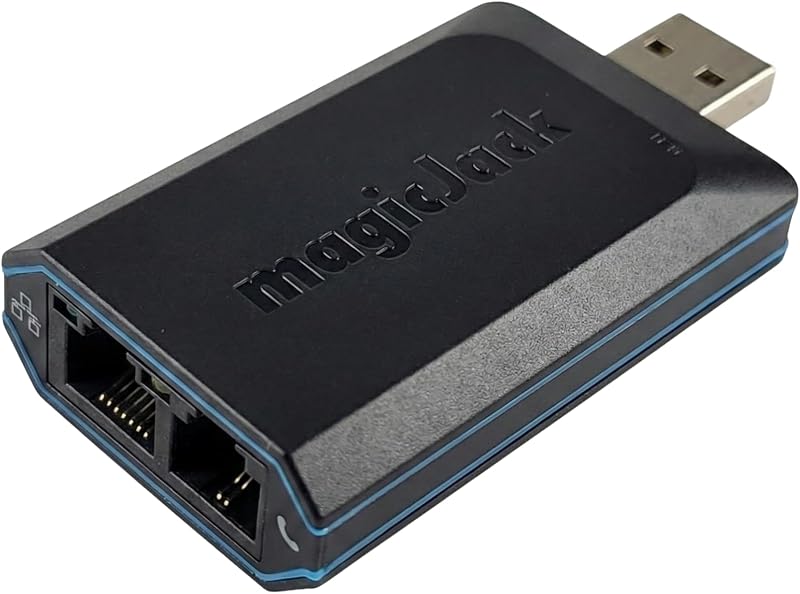
| magicJack VOIP Phone Adapter | Budget Residential Calling | Includes unlimited calling to US and Canada with magicIN/magicOUT service without open SIP trunk support. |
| Ooma Telo VoIP Free Internet | Proprietary Home Telephony | Designed specifically for the consumer Ooma Telo VoIP free internet home phone ecosystem. |
| Polycom Inc. OBI 300 Voice | Single-Line Specialized Voice | Provides 1 FXS ATA port with a USB interface and specifically needs a paid subscription to operate. |
Evaluating the HT802 V2 vs OBi 300 alongside residential options highlights sharp architectural boundaries. Select the Grandstream adapter when your infrastructure demands two open-standard SIP lines, carrier-grade encryption, and enterprise mass provisioning. In contrast, opt for the magicJack VOIP Phone Adapter if you need an inexpensive consumer device bundled with North American calling, choose the Ooma Telo VoIP Free Internet if you prefer a closed consumer home phone platform, or select the Polycom Inc. OBI 300 Voice if your voice architecture requires a single FXS port with a USB interface that operates under a paid service subscription.
08 Bottom Line
When determining whether the Grandstream HT802 V2 is worth it for your business, the answer is an emphatic yes for organizations seeking a proven, standard-compliant bridge between analog equipment and IP telephony. Its support for two distinct SIP profiles across dual FXS ports, coupled with hardware-level TLS/SRTP encryption and robust T.38 fax handling, makes it an indispensable tool for preserving legacy analog infrastructure without compromising modern voice security.
For system integrators, telecom consultants, and enterprise network engineers managing distributed offices, this adapter delivers the automated provisioning and failover reliability required for enterprise-grade service delivery. As long as initial firmware updates are applied immediately upon deployment, the HT802 V2 stands as one of the most reliable and efficient dual-port analog adapters available for commercial VoIP voice integration.
09 FAQ
What makes the Grandstream HT802 V2 suitable for enterprise office environments?
The Grandstream HT802 V2 for office installations is engineered with dual FXS ports that support two independent SIP profiles, multi-line operation, and basic three-way conferencing. It features carrier-grade TLS and SRTP encryption to safeguard business communication, alongside failover SIP server functionality to prevent service interruptions if the primary registrar fails.
Does the Grandstream HT802 V2 support physical fax machines?
Yes. The adapter includes native support for the T.38 Fax protocol, which converts analog facsimile tones into reliable digital data packets. This dedicated Grandstream HT802 V2 fax over IP functionality ensures stable transmission across broadband networks, allowing companies to retain legacy physical fax machines without relying on traditional analog copper phone lines.
How is automated provisioning managed on this adapter?
Large-scale Grandstream HT802 V2 provisioning is conducted through TR-069 management protocols or structured XML configuration files pushed remotely. Additionally, when connected to Grandstream UCM series IP PBXs, the unit supports Zero Configuration provisioning, allowing the PBX to discover the adapter automatically by MAC address and apply settings without manual intervention.
Why is immediate firmware upgrading recommended for this unit?
Grandstream strongly recommends that all HT802 V2 units be updated to firmware version 1.0.19.11 or the latest official release immediately upon installation. Updating the firmware ensures optimal SIP compatibility, resolves known operational bugs, enhances system security, and delivers stable voice and fax performance across different network environments.
What types of terminal equipment can be connected to the FXS ports?
The adapter is compatible with standard corded analog telephones, multi-line telephone systems, PSTN and ISDN premise wiring, legacy physical fax machines, and building peripheral hardware such as paging amplifiers or analog door intercoms that connect via standard RJ-11 telephone cabling.