As Amazon Associates, we earn from qualifying purchases. This means we may receive a small commission at no extra cost to you if you click through and make a purchase.
As an Amazon Associate we earn from qualifying purchases. Links on this page are affiliate links.
Choosing between an AFWFilters vs DuraWater water softener depends on your specific water issues. Both systems use the reliable Fleck 5600 SXT control valve and target whole-house treatment. They share similar tank dimensions, making installation straightforward for most homes. The main difference lies in their technology and target contaminants. AFWFilters focuses on standard hardness removal with durable resin, while DuraWater uses air injection to tackle iron and sulfur. You must decide which contaminant matters most to your household.
Control Valve
Fleck 5600SXT
Fleck 5600 SXT
Technology
Ion Exchange
Air Injection
Media Type
10% crosslink resin
not listed
Target Contaminant
Chlorine, Hardness
Iron, Manganese, H2S
Grain Capacity
48,000
not listed
Choose the first if
- You need to remove standard hard water minerals and scale.
- You want a system with a specified 48,000 grain capacity.
- You prefer 10% crosslink resin for chlorine resistance.
Choose the second if
- You have high levels of iron or manganese in your water.
- You want to remove hydrogen sulfide (sulfur) smells.
- You prefer an air injection method without chemicals.
Verdict
Choose the AFWFilters model if your primary concern is general hardness and scale prevention. Select the DuraWater system if you are dealing with significant iron, manganese, or sulfur issues. Both use the same trusted valve, so your choice hinges on the specific contaminants in your water supply.
01 AFWFilters vs DuraWater: Softener Specs
Target contaminant
Edge: Tie
AFWFilters focuses on eliminating hard water minerals and scale. It uses 10% crosslink resin to help resist chlorine while reducing mineral deposits. DuraWater targets iron, manganese, and hydrogen sulfide (H2S). It uses air injection technology to remove iron up to 10-15 ppm. If your main issue is general hardness, AFWFilters is the better choice. If you have high iron or sulfur smells, DuraWater’s air injection method is more effective. The two systems address different primary water quality problems.
Grain capacity
Edge: AFWFilters 48k Grain Black Softener
AFWFilters offers a 48,000 grain capacity. This rating indicates how much hardness the resin can remove before regeneration. DuraWater lists a 1 cubic foot media volume but does not provide a specific grain capacity rating. Generally, a 1 cubic foot load provides roughly 20,000 to 25,000 grains of capacity depending on the resin type. AFWFilters likely has a higher capacity due to its specific 48k rating and optimized resin load. You should choose AFWFilters if you need a higher capacity for a larger household or harder water.
Resin technology
Edge: Tie
AFWFilters uses 1.5 cubic feet of 10% crosslink resin. This media is designed to maintain exchange performance and resist chlorine damage, extending softening life. DuraWater uses air injection technology with 1 cubic foot of media. This method oxidizes iron and manganese before they settle. AFWFilters resin is better for general softening and chlorine resistance. DuraWater’s air injection is superior for removing specific contaminants like iron and sulfur. Your water test results should dictate which technology you need for your specific supply.
Control valve
Edge: Tie
Both systems use the Fleck 5600 SXT control valve. This is a widely used, reliable digital valve in the water treatment industry. It manages the regeneration cycles for both units. Since the valve is identical, the operational logic and programming features are the same for both products. You will get the same user interface and control capabilities regardless of which brand you select. This similarity simplifies maintenance and troubleshooting since the parts are compatible across both systems.
Physical dimensions
Edge: DuraWater Air Injection Iron Eater
Both units share identical tank dimensions: 10 inches in width and length, and 54 inches in height. The installed height is 62 inches for AFWFilters. DuraWater matches this footprint exactly. This consistency means the space required for installation is the same for both. You can use the same plumbing layout and clearance requirements for either system. The only difference is weight; AFWFilters weighs 130 pounds, while DuraWater weighs 86 pounds. The lighter DuraWater unit may be slightly easier to handle during installation.
02 Which Water Softener Fits Your Needs
Homeowners with hard water and chlorine exposure
Our pick: AFWFilters 48k Grain Black Softener
This AFWFilters model uses 10% crosslink resin, which helps resist chlorine damage while softening water. It offers a 48,000 grain capacity to handle high mineral loads. The system targets scale and soap scum, protecting your pipes and skin from hard water effects.
Users dealing with iron, manganese, or sulfur
Our pick: DuraWater Air Injection Iron Eater
The DuraWater unit employs air injection technology specifically for removing iron, manganese, and hydrogen sulfide. It handles up to 10-15 ppm of iron without chemicals. This makes it the practical choice when your water supply contains significant metallic or sulfur issues rather than just hardness.
Buyers seeking a lighter, simpler installation
Our pick: DuraWater Air Injection Iron Eater
Weighing only 86 pounds, this DuraWater system is significantly lighter than the 130-pound AFWFilters option. Both share identical 10-inch by 54-inch tank dimensions and use the Fleck 5600 SXT valve. The reduced weight simplifies handling during setup for whole-house plumbing integration.
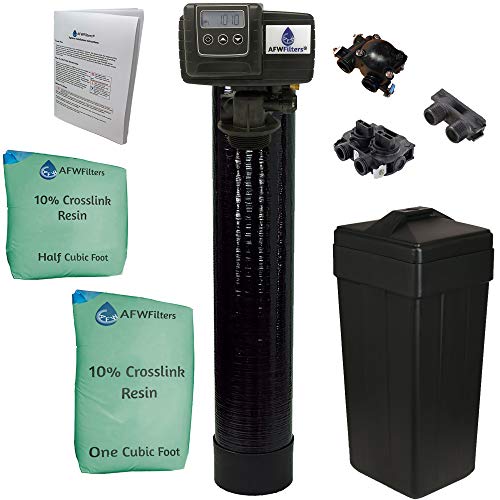
AFWFilters 48k Grain Black Softener
Best for: small households needing reliable softening
- Grain Capacity
- 48,000
- Installation Type
- Whole House
- Control Valve
- Fleck 5600SXT
- Media Type
- 10% crosslink resin
- Port Size
- 1" NPT
- Target Contaminant
- Chlorine
This whole-house system uses a Fleck 5600SXT valve and 1.5 cubic feet of 10% crosslink resin to soften water. It offers a 48,000-grain capacity and 1-inch NPT connections for standard plumbing. The resin resists chlorine, extending softening life. It fits homes needing reliable mineral removal with a compact 10-inch diameter tank. The unit weighs 130 pounds and includes brine and mineral tanks.
- 48,000-grain capacity for whole-house use
- 10% crosslink resin resists chlorine damage
- Fleck 5600SXT digital control valve
- 1-inch NPT inlet and outlet ports
- 1.5 cubic feet of treatment media
- 130-pound weight requires sturdy floor support
- 48,000-grain capacity suits smaller households
- 10-inch tank diameter limits media volume
- You need a whole-house softener for a small family
- You want chlorine-resistant resin for longer life
- You have space for a 10-inch diameter tank
- You require high-flow capacity for large homes
- You need a salt-free conditioning system
- You want a compact under-sink unit
Verdict: AFWFilters 48K Grain Water Softener delivers reliable softening for smaller households with its chlorine-resistant resin and standard 1-inch connections. It fits buyers prioritizing durable media and established valve technology over high-capacity volume.

DuraWater Air Injection Iron Eater
Best for: moderate iron removal in whole homes
- Technology
- Air Injection
- Installation Type
- Whole Home
- Control Valve
- Fleck 5600 SXT
- Target Contaminant
- Iron, Manganese
- Dimensions
- 10 × 10 × 54 inches
- Weight
- 86 pounds
This DuraWater whole-home filter uses air injection to remove iron and manganese from your water. It features a Fleck 5600 SXT control valve and holds 1 cubic foot of media. The unit measures 10 by 54 inches and weighs 86 pounds. It handles iron levels up to 15 ppm. This system is designed for easy installation and automatic operation without chemicals.
- Air injection technology for high iron removal
- Fleck 5600 SXT control valve
- Removes iron up to 15 ppm
- Whole-home treatment capacity
- Heavy 86-pound build requires sturdy support
- 54-inch height needs vertical clearance
- Limited to 1 cubic foot of media
- You have iron levels up to 15 ppm
- You want automatic whole-home filtration
- You prefer chemical-free water treatment
- You need to remove iron above 15 ppm
- You have limited vertical installation space
- You require a smaller footprint unit
Verdict: DuraWater Air Injection Iron Filter provides reliable whole-home protection for moderate iron levels. It fits homes with standard ceiling heights and a need for chemical-free filtration.
03 Specifications side by side
| Spec | AFWFilters 48k Grain Black Softener | DuraWater Air Injection Iron Eater |
|---|---|---|
| Grain Capacity | 48,000 | – |
| Technology | – | Air Injection |
| Installation Type | Whole House | Whole Home |
| Control Valve | Fleck 5600SXT | Fleck 5600 SXT |
| Media Type | 10% crosslink resin | – |
| Port Size | 1" NPT | – |
| Capacity | 48,000 Grain | – |
| Target Contaminant | Chlorine | Iron, Manganese |
| Intended Use | – | Home |
| Dimensions | 10 × 10 × 54 inches | 10 × 10 × 54 inches |
| Weight | 130 pounds | 86 pounds |
| Size | 48,000 | 1 cu ft |
| Color | Black | Almond |
| Model | WS48-56SXT-10 | AIHD-almond |
04 Frequently asked questions
Which softener handles higher mineral loads?
The AFWFilters 48k Grain Black Softener handles higher mineral loads. It offers a 48,000 grain capacity for whole-house treatment. This makes it suitable for small households needing reliable softening. The DuraWater Air Injection Iron Eater focuses on iron and manganese removal rather than high-capacity softening. Its 1 cubic foot size targets moderate iron levels in homes.
Are the tank sizes similar for installation?
Both units share identical tank dimensions for easy installation. Each system measures 10 inches in width and length, with a height of 54 inches. The AFWFilters model weighs 130 pounds, while the DuraWater unit weighs 86 pounds. These standard sizes fit most utility spaces without requiring major structural modifications to your home.
What contaminants does the AFWFilters system remove?
The AFWFilters 48k Grain Black Softener targets chlorine and hard water minerals. It uses chlorine-resistant resin to protect against damage while reducing scale. This system is designed for whole-house treatment. It prioritizes durable media and established valve technology to ensure consistent water quality for your household needs.
How does the DuraWater system remove iron?
The DuraWater Air Injection Iron Eater uses air injection technology to remove iron and manganese. This method provides chemical-free filtration for whole-home protection. It is best for homes with moderate iron levels. The almond-colored unit weighs 86 pounds and fits standard ceiling heights for straightforward placement.
Which model is better for chlorine exposure?
The AFWFilters 48k Grain Black Softener is better for chlorine exposure. Its 10% crosslink resin helps resist chlorine damage while softening water. This feature protects the system and ensures durable media performance. The DuraWater model focuses on iron and manganese removal, making it less ideal if chlorine resistance is your primary concern.
Do both systems use the same control valve?
Yes, both systems use the Fleck 5600 SXT control valve. This standard valve ensures reliable operation for whole-house treatment. It manages the regeneration cycles for both softening and filtration processes. This shared component means maintenance and operation principles are similar for both the AFWFilters and DuraWater units.
Which unit is heavier and why?
The AFWFilters 48k Grain Black Softener is heavier at 130 pounds. The DuraWater Air Injection Iron Eater weighs 86 pounds. The weight difference reflects the higher 48,000 grain capacity and larger resin volume in the AFWFilters model. This additional mass supports its role in handling higher mineral loads for small households.


