As Amazon Associates, we earn from qualifying purchases. This means we may receive a small commission at no extra cost to you if you click through and make a purchase.
As an Amazon Associate we earn from qualifying purchases. Links on this page are affiliate links.
You are comparing the 11 pure to drain vs 251 pure to drain reverse osmosis system options. Both are tankless under-sink units that save cabinet space. They differ in output capacity and water efficiency. The Waterdrop G2 produces 400 GPD with a 1:1 ratio. The iSpring RCS10T produces 1000 GPD with a 2.5:1 ratio. Your choice depends on your daily water needs and drain water tolerance.
Daily Production Rate
400 GPD
1000 GPD
Pure to Drain Ratio
1:1
2.5:1
Filtration Stages
7-stage
5-stage
Features
Tankless
Tankless, Booster Pump
Certifications
NSF/ANSI 372
not listed
Installation Type
Under-sink
Under-sink
Choose the first if
- You need a system with a 1:1 pure to drain ratio to minimize wastewater.
- You prefer a 7-stage filtration process for potentially broader contaminant reduction.
- You have lower daily water demands and do not need high flow rates.
Choose the second if
- You require up to 1000 GPD for high water usage households.
- You want a 2.5:1 pure to drain ratio for better water efficiency.
- You have low inlet water pressure and need a built-in booster pump.
Verdict
Choose the Waterdrop G2 if you prioritize a lower drain ratio and additional filtration stages for standard household use. Select the iSpring RCS10T if you need higher daily output and improved performance in low-pressure conditions. Both systems offer tankless convenience and under-sink installation.
01 1:1 vs 2.5:1 RO System Specs
Pure to drain ratio
Edge: iSpring RCS10T 1000 GPD Tankless RO
Water efficiency is a major difference between these two tankless reverse osmosis systems. The Waterdrop G2 operates with a 1:1 pure to drain ratio. This means it produces one gallon of purified water for every one gallon of wastewater sent to the drain. In contrast, the iSpring RCS10T features a 2.5:1 pure to drain ratio. It yields two and a half gallons of clean water for each gallon of waste. The higher ratio of the iSpring system indicates better water conservation during the filtration process. If minimizing wastewater is your priority, the iSpring design offers a clear advantage in efficiency.
Daily production rate
Edge: iSpring RCS10T 1000 GPD Tankless RO
Output capacity determines how quickly you can fill containers or cook meals. The Waterdrop G2 has a daily production rate of 400 gallons per day. This is sufficient for most standard household needs. The iSpring RCS10T delivers up to 1000 gallons per day. This significantly higher capacity supports larger families or high-volume usage without delay. The iSpring system is engineered for higher daily water demands in residential or light commercial settings. If you need faster access to filtered water, the iSpring model provides a substantial advantage in volume.
Filtration stages
Edge: Waterdrop G2 400 GPD Tankless RO
The filtration architecture differs in complexity between these units. The Waterdrop G2 utilizes a 7-stage filtration process. It uses a composite filter result for effective filtration and is certified by NSF/ANSI 372 for lead-free materials. The iSpring RCS10T employs a 5-stage filtration system. It focuses on reducing over 1,000 common contaminants, including chlorine, fluoride, lead, and arsenes, with a high-efficiency RO membrane that rejects up to 99% of total dissolved solids. The Waterdrop offers more stages, while the iSpring targets broad contaminant reduction with fewer steps.
Booster pump
Edge: iSpring RCS10T 1000 GPD Tankless RO
Water pressure management varies between the two designs. The iSpring RCS10T includes a built-in high-efficiency booster pump. This component increases inlet pressure, allowing the RO membrane to operate at optimal efficiency even in low water pressure conditions. This maximizes purified water production and system reliability. The Waterdrop G2 specifications do not mention an integrated booster pump. It relies on its standard tankless design for operation. If your home has low water pressure, the iSpring pump provides a functional advantage for consistent performance.
Installation type
Edge: Tie
Both systems are designed for under-sink installation. They are tankless units that save cabinet space compared to traditional systems with storage tanks. The Waterdrop G2 requires an electrical outlet and drilling holes to operate. It features an integrated design that reduces leakage and noise. The iSpring RCS10T is also an under-sink unit with quick-fitting connections for DIY installation. Both require space under the sink. Since both share the same fundamental installation requirements and tankless form factor, neither has a distinct edge in this category.
02 Choose the Right RO System for You
Low pressure or high volume needs
Our pick: iSpring RCS10T 1000 GPD Tankless RO
The iSpring RCS10T delivers 1000 GPD and includes a built-in booster pump. This pump increases inlet pressure, ensuring optimal membrane performance even in low-pressure environments. Its 2.5:1 pure-to-drain ratio is more water-efficient than the 1:1 ratio found in the Waterdrop G2, making it better for larger households or commercial use.
Compact space with moderate needs
Our pick: Waterdrop G2 400 GPD Tankless RO
The Waterdrop G2 is smaller, measuring 5.9 by 14 inches, and weighs 25 pounds. It produces 400 GPD with a 1:1 drain ratio. Its 7-stage filtration uses composite filters and is NSF/ANSI 372 certified for lead-free materials. The twist-and-pull filter design allows for quick replacement, fitting well in tight under-sink cabinets.
Budget-conscious efficiency seekers
Our pick: Waterdrop G2 400 GPD Tankless RO
You get a 1:1 pure-to-drain ratio with the Waterdrop G2, which saves water compared to older systems. It offers 400 GPD output, providing a cup of water in about 12 seconds. The tankless design saves storage space, and the integrated electrical and water circuits reduce leakage risks while keeping noise levels low.
| # | Product | Best for | Price |
|---|---|---|---|
| 1 | Waterdrop G2 400 GPD Tankless RO | small households needing efficient water use | |
| 2 | iSpring RCS10T 1000 GPD Tankless RO | High-flow households with low pressure |

Waterdrop G2 400 GPD Tankless RO
Best for: small households needing efficient water use
- Pure to Drain Ratio
- 1:1 Pure to Drain
- Installation Type
- Under-sink
- Daily Production Rate
- 400 GPD
- Filtration Stages
- 7-stage
- Certifications
- NSF/ANSI 372
- Features
- Tankless
The Waterdrop G2 is a tankless reverse osmosis system with a 400 GPD production rate and a 1:1 pure to drain ratio. It uses a 7-stage filtration process and holds NSF/ANSI 372 certification for lead-free materials. The compact unit measures 17.3 by 5.9 by 14 inches. You will need an under-sink electrical outlet for operation. This system suits you if you prioritize water efficiency and quick filter changes over higher daily output.
- 1:1 pure to drain ratio saves water
- 400 GPD daily production rate
- NSF/ANSI 372 certified for lead-free materials
- 7-stage filtration system
- Tankless design saves under-sink space
- 1:1 pure to drain ratio wastes more water than 2.5:1 systems
- 400 GPD capacity is lower than 1000 GPD alternatives
- Requires under-sink electrical outlet
- You want a 1:1 pure to drain ratio
- You need a tankless system under the sink
- You prefer 7-stage filtration
- You need a 1000 GPD production rate
- You want a 2.5:1 pure to drain ratio
- You have no under-sink electrical outlet
Verdict: Waterdrop G2 400 GPD Tankless RO fits you if you need a compact, water-efficient system with certified materials and do not require high-volume output. It is a practical choice for small households prioritizing space and efficiency.
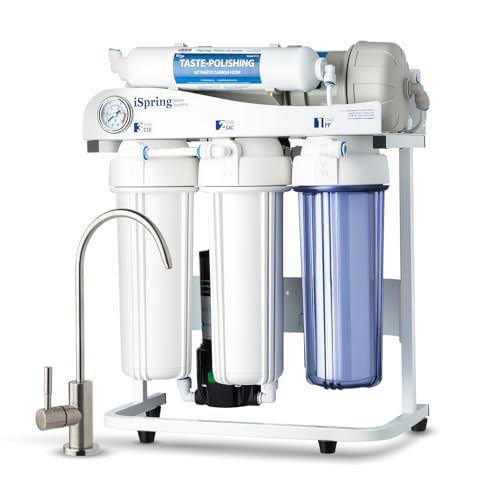
iSpring RCS10T 1000 GPD Tankless RO
Best for: High-flow households with low pressure
- Pure to Drain Ratio
- 2.5:1 Pure to Drain
- Daily Production Rate
- 1000 GPD
- Filtration Stages
- 5-Stage
- Features
- Tankless, Booster Pump
- Dimensions
- 15.6 × 8.66 × 19.3 inches
- Weight
- 28.7 pounds
This iSpring system delivers 1000 gallons per day with a 2.5:1 pure-to-drain ratio. It uses a 5-stage filtration process and includes a built-in booster pump to handle low inlet pressure. The tankless design saves under-sink space. It suits households with high daily water needs or light commercial use. You get reliable purified water without the bulk of a storage tank.
- 1000 GPD daily production rate
- 2.5:1 pure-to-drain efficiency ratio
- Built-in high-efficiency booster pump
- 5-stage filtration reduces 99% of contaminants
- Heavier at 28.7 pounds
- Larger footprint measuring 19.3 inches tall
- Higher initial capacity than standard 400 GPD units
- You need high daily water output
- You have low inlet water pressure
- You want to save under-sink space
- You have limited under-sink height
- You prefer a lighter unit
- You only need basic filtration
Verdict: iSpring RCS10T 1000 GPD Tankless RO fits homes needing high flow and efficiency. It handles low pressure well and saves space.
03 Specifications side by side
| Spec | Waterdrop G2 400 GPD Tankless RO | iSpring RCS10T 1000 GPD Tankless RO |
|---|---|---|
| Installation Type | Under-sink | – |
| Daily Production Rate | 400 GPD | 1000 GPD |
| Filtration Stages | 7-stage | 5-Stage |
| Pure to Drain Ratio | 1:1 | 2.5:1 |
| Certifications | NSF/ANSI 372 | – |
| Features | Tankless | Tankless, Booster Pump |
| Dimensions | 17.3 × 5.9 × 14 inches | 15.6 × 8.66 × 19.3 inches |
| Weight | 25 pounds | 28.7 pounds |
| Size | 400 GPD | 1000 GPD RO Tankless |
| Color | White | White |
| Model | WD-G2-W | RCS10T |
04 Frequently asked questions
Is a 1:1 pure to drain ratio better than 2.5:1?
A 1:1 ratio is more water-efficient than a 2.5:1 ratio. The Waterdrop G2 uses this efficient design, producing one gallon of purified water for every gallon of wastewater. This makes it ideal if you want to minimize water waste. The iSpring model uses a 2.5:1 ratio, which wastes more water but offers higher flow rates.
Which system produces more water per day?
The iSpring RCS10T produces significantly more water. It has a capacity of 1000 GPD, while the Waterdrop G2 produces 400 GPD. If your household needs high-volume output for cooking or filling large containers, the iSpring is the better choice. The Waterdrop is sufficient for smaller households with moderate water needs.
Do I need a booster pump for low water pressure?
Yes, if your home has low water pressure, a booster pump helps. The iSpring RCS10T includes a built-in booster pump to increase inlet pressure. This ensures optimal membrane performance even in low-pressure environments. The Waterdrop G2 does not list a booster pump, so it may perform poorly in low-pressure settings.
How much space do these tankless RO systems take up?
Both systems are tankless and fit under your sink. The Waterdrop G2 is narrower at 5.9 inches wide. The iSpring RCS10T is wider at 8.66 inches. Both are compact compared to traditional systems with storage tanks. You should measure your cabinet space to ensure the unit fits comfortably alongside your pipes.
What filtration stages do these systems use?
The Waterdrop G2 uses a 7-stage filtration process. The iSpring RCS10T uses a 5-stage process. More stages can provide additional layers of filtration, though both remove common contaminants. The specific stages are not detailed in the data, but the difference in count is a key spec to consider for your water quality needs.
Which RO system is lighter?
The Waterdrop G2 is lighter at 25 pounds. The iSpring RCS10T weighs 28.7 pounds. The weight difference is small but may matter if you need to move the unit for installation or maintenance. Both are designed for under-sink installation, so the weight is manageable for most homeowners.


